
The latest from RIO! 😎 pic.twitter.com/OBBtFjGNvn
— Renee Anne Shirley (@RAnneShirley) August 4, 2016
Showing posts with label blood doping. Show all posts
Showing posts with label blood doping. Show all posts
Wednesday, August 03, 2016
Doping Humor

Saturday, August 01, 2015
Doping in Athletics
Here's the documentary on Kenya/Russian Doping in English- http://t.co/0CduaiHdFu
— steve magness (@stevemagness) August 1, 2015Thursday, August 21, 2014
Mead 6th in 13:07 in Stockholm; Waseca; Goucher "Trending;" Rochester Races; Eagan's LaChance & Van Wyk; Maple Grove's Dickerson; Drug Test Data
Hassan Mead runs 13:07.81 for sixth in the Stockholm DN Galan Meet. Result is HERE.
Waseca County News article on the Waseca HS XC teams and their current "streak" HERE.
Third Kara Goucher article this week. She must be "trending." HERE. And then there's Kara's blog HERE.
Rochester Post-Bulletin on the Mayo Clinic, Rochester Track Club, and the City of Rochester combining for the Mayo Clinic Human Race weekend running events and clinics HERE.
Strib on Eagan HS XC runners Anna Van Wyk HERE, Bailey LaChance HERE. Maple Grove's Mitchell Dickerson HERE.
Drug testing stats for all sports HERE. Comparison between 2012-13, number of blood tests done per sport.
Waseca County News article on the Waseca HS XC teams and their current "streak" HERE.
Third Kara Goucher article this week. She must be "trending." HERE. And then there's Kara's blog HERE.
Rochester Post-Bulletin on the Mayo Clinic, Rochester Track Club, and the City of Rochester combining for the Mayo Clinic Human Race weekend running events and clinics HERE.
Strib on Eagan HS XC runners Anna Van Wyk HERE, Bailey LaChance HERE. Maple Grove's Mitchell Dickerson HERE.
Drug testing stats for all sports HERE. Comparison between 2012-13, number of blood tests done per sport.
Wednesday, October 17, 2012
Lance's Legacy
By Jim Ferstle
Lance Armstrong is a survivor. He survived a broken home, essentially growing up without a father. He survived cancer. Now he has to survive a test of his own making. The USADA's "reasoned decision" as the file on the investigation of doping on the US Postal/Discovery teams documents has been labelled, documents in detail what has been known in the cycling community for years. Doping was part of the culture. It was perceived as the only way to the top of the sport and was part of the mantra: "Everybody is doing it."
Everybody wasn't doing it, but enough were to transform the sport of cycling. The same could be said during this era about other sports, including track and field, and with the introduction of blood doping and use of rhuEPO, distance running. At a conference on the topic of doping in sport in the late 1990s at Duke University, Alberto Salazar was one of the speakers. He told the group that he was reluctant to encourage his own kids or anybody else's to get into the sport because it was perceived that doping was necessary to rise to the top.
In 1984, John Treacy, an Irish runner who later that year won a silver medal in the Olympic marathon and already twice won the World XC Championships, walked into a bathroom at the Meadowlands prior to the start of that year's IAAF World XC championships. There he saw members of the Spanish team injecting themselves with a red substance in syringes. Years later, I was at the table in a restaurant in the New York Hilton during New York City Marathon weekend with John, Minnesotans Mark Nenow and Steve Plasencia, Steve Scott, and other top runners of the era.
Talk got around to doping, and John reiterated his own vehement opposition to the notion that you had to do it to succeed. He knew others were doping. He knew it was a big problem in the sport that wasn't being properly addressed by the sports governing bodies. But that didn't make him believe he had to dope. He derived great satisfaction, he said, by beating the runners he believed were doping. Today John is the head of the Irish Sports Council, whose anti-doping unit polices the doping issue in Ireland.
Running has always had the advantage of being an individual sport where you won or lost based on your own talent and ability to perform. It wasn't the sort of team effort or culture where others could be pressured to give in to the temptation to dope just to keep one's "job" or stay at that level of the sport. The pressure to dope just to survive wasn't as intense, yet, as the recent case of California runner Christian Hesch illustrates, doping can be a strong temptation not only for Olympic level athletes, but for others as well.
Hesch only came forward with a confession of his guilt for using rhuEPO after he was caught by teammates who threatened to turn him in to USADA. Armstrong missed his first opportunity to join the other cyclists who admitted their use of drugs and accept a more lenient punishment by helping the agency attempt to get at the roots of the problem, the suppliers, enablers of doping that make the practice possible. Thomas Bach, and IOC VP, has urged Armstrong not to miss another, to "come clean," to essentially be part of the solution to the doping in sports cycle instead of part of the problem.
When Armstrong got cancer he devoted his considerable energy and determination toward dealing with his illness. Then he took one step further by trying to be part of the solution to the curse of cancer. Nobody expects him to confess. To tell all he knows about the dark underbelly of sports. But it would be, perhaps, a greater achievement than finishing first in the Tour de France seven times. If Lance Armstrong wants to be remembered for what he did for sport, he has a chance to step up and be remembered not as what Greg LeMond has called the sport's greatest fraud, but rather as someone who contributed to changing the course of modern sport. If he wants to be remembered for the good he has done or forgiveness for the damage he's caused, now is the time to earn it.
Lance Armstrong is a survivor. He survived a broken home, essentially growing up without a father. He survived cancer. Now he has to survive a test of his own making. The USADA's "reasoned decision" as the file on the investigation of doping on the US Postal/Discovery teams documents has been labelled, documents in detail what has been known in the cycling community for years. Doping was part of the culture. It was perceived as the only way to the top of the sport and was part of the mantra: "Everybody is doing it."
Everybody wasn't doing it, but enough were to transform the sport of cycling. The same could be said during this era about other sports, including track and field, and with the introduction of blood doping and use of rhuEPO, distance running. At a conference on the topic of doping in sport in the late 1990s at Duke University, Alberto Salazar was one of the speakers. He told the group that he was reluctant to encourage his own kids or anybody else's to get into the sport because it was perceived that doping was necessary to rise to the top.
In 1984, John Treacy, an Irish runner who later that year won a silver medal in the Olympic marathon and already twice won the World XC Championships, walked into a bathroom at the Meadowlands prior to the start of that year's IAAF World XC championships. There he saw members of the Spanish team injecting themselves with a red substance in syringes. Years later, I was at the table in a restaurant in the New York Hilton during New York City Marathon weekend with John, Minnesotans Mark Nenow and Steve Plasencia, Steve Scott, and other top runners of the era.
Talk got around to doping, and John reiterated his own vehement opposition to the notion that you had to do it to succeed. He knew others were doping. He knew it was a big problem in the sport that wasn't being properly addressed by the sports governing bodies. But that didn't make him believe he had to dope. He derived great satisfaction, he said, by beating the runners he believed were doping. Today John is the head of the Irish Sports Council, whose anti-doping unit polices the doping issue in Ireland.
Running has always had the advantage of being an individual sport where you won or lost based on your own talent and ability to perform. It wasn't the sort of team effort or culture where others could be pressured to give in to the temptation to dope just to keep one's "job" or stay at that level of the sport. The pressure to dope just to survive wasn't as intense, yet, as the recent case of California runner Christian Hesch illustrates, doping can be a strong temptation not only for Olympic level athletes, but for others as well.
Hesch only came forward with a confession of his guilt for using rhuEPO after he was caught by teammates who threatened to turn him in to USADA. Armstrong missed his first opportunity to join the other cyclists who admitted their use of drugs and accept a more lenient punishment by helping the agency attempt to get at the roots of the problem, the suppliers, enablers of doping that make the practice possible. Thomas Bach, and IOC VP, has urged Armstrong not to miss another, to "come clean," to essentially be part of the solution to the doping in sports cycle instead of part of the problem.
When Armstrong got cancer he devoted his considerable energy and determination toward dealing with his illness. Then he took one step further by trying to be part of the solution to the curse of cancer. Nobody expects him to confess. To tell all he knows about the dark underbelly of sports. But it would be, perhaps, a greater achievement than finishing first in the Tour de France seven times. If Lance Armstrong wants to be remembered for what he did for sport, he has a chance to step up and be remembered not as what Greg LeMond has called the sport's greatest fraud, but rather as someone who contributed to changing the course of modern sport. If he wants to be remembered for the good he has done or forgiveness for the damage he's caused, now is the time to earn it.
Thursday, October 11, 2012
Wednesday, October 10, 2012
It's Not About the Dopes: Why the US Postal Case Matters

If you think the much publicized USADA prosecution of the doping conspiracy case against the US Postal cycling team is all about Lance Armstrong and the US Anti Doping Agency, you're wrong. It is much more than that. At it's core it is the attempt by USADA to tackle their greatest challenge, exposing and punishing what can generically be called "the sophisticated doper," athletes who not only use performance enhancing substances(PEDs), but also resort to extraordinary means to prevent people from exposing what they are doing.
For as long as I've written about this topic(since 1987) the frustration of those who operate the drug testing labs, and those charged with uncovering and prosecuting doping offenders has been that the vast majority of the people they caught breaking the rules were what you could call "low hanging fruit," the athletes who often accidentally ingested a contaminated supplement or "inadvertently" were caught with a banned substance in their urine. These were not hard core cheaters who bought into the win at all costs mentality, but rather careless individuals who made mistakes.
But the current prosecution takes direct aim at the US Postal Six, the alleged ringleaders of "the most sophisticated, professionalized and successful doping program that the sport has ever seen," according to USADA. The aim is to expose the lengths to which some will go to achieve success in sport. As I've often told those who ask why I'm still interested in this topic after a quarter of a century I say that it encapsulates the best--athletes striving to be the best they can be in their chosen hobby/profession--with the depths to which they will go to achieve those goals. It is a fascinating study of human nature.
It's a topic that involves psychology, physiology, pharmacology, ethics, morality, and a host of other fields. In literary terms it is Shakespeare in spikes, a fascinating journey through shades of gray, as well as black and white. The technological and social changes of the last 50 years has transformed society and this is reflected in our views on sports. They have been transformed from the games we played for fitness and recreation or watched to be amazed by the exhibition of physical talent, to entertainment and recreation businesses that generate billions of dollars in revenue.
This has an impact not only in economic terms, but in social ones as well. Sports "stars" become celebrities with influence rivaling, if not surpassing, those in other professions and an income to match that status. College scholarships are almost the equivalent of a four-year salaried career and as much a sought after goal as a short term professional sports contract for those not gifted enough to make the "big leagues." All this leads to a "trickle down" effect. The pressure to perform is not only on the small minority of the greatly athletically gifted, but also to the families of those who want their children to get a good college education, but can't afford it any other way.
Doping is not just for Olympians or professional athletes anymore. Masters cyclists are getting busted for using recombinant erythropoietin(EPO), the blood boosting drug that is one of the most potent performance enhancers used by athletes. This reality of modern sport is only getting more advanced as another coach told me recently that research into genes, receptor cells, and the mysteries of how the body does what it does is unlocking a whole new territory/definition of doping. Instead of injecting oneself with pharmaceuticals, the next generation of performance enhancers will be manipulating one's cellular functions and capabilities to do what PEDs do today without the potential negative side effects.
Why all this matters is that the "culture" of top level and elite level high school sport has changed. People have always cheated, but it was usually a singular, individual indiscretion. Now it's an industry. It's not merely one off doping, it's a sophisticated system of manufacture, delivery, and consumption of products and services provided to give an athlete "the edge" on the competition. To break that culture, the most potent battleground is on the level of the sophisticated cheaters. They are the "role models," the engine driving the doping train.
When the BALCO case broke, many of the athletes who were caught were not the big name stars, but those striving to reach that status. Many of them struggled with the decision to dope and, when caught, ultimately confessed to their "sins." But when asked to go the "extra mile," to give up their suppliers, to tell the full story of the network that was set up to service this industry, they balked. Marion Jones, who had not and ultimately was not convicted of a doping offense, was frequently cited by these individuals who said: "Why aren't you going after her? Why haven't you busted her?"
To kill the beast, you have to cut off its head. The head of the doping beast is the sophisticated doper and the enablers around him or her. That is why the US Postal case matters. To change the doping culture, you have to demonstrate that no matter who you are or when you did it, there is a price to pay. A price commensurate with the crime. For the US Postal Six this is not a "witch hunt" or an unfair targeting of individuals. It is an attempt to change the culture. To return sport to the best athletes. This case will not accomplish that in one fell swoop, but it is a step in the right direction.
For details of the USADA/US Postal case go HERE.
Tuesday, October 09, 2012
Scientists' Debate: Parisotto's Closing Arguments
After a break for our Medtronic TCM Marathon coverage, we have reached the point of "closing arguments" in the scientific debate between Robin Parisotto and Dr. Michele Ferrari regarding what may be a small piece of the file USADA will soon send to WADA and UCI regarding the doping conspiracy case they pursued on cyclist Lance Armstrong. The debate began with Parisotto's original analysis of some of the data (HERE) Armstrong had published on his website during his comeback to cycling in 2009 and an invitation to readers to "peak behind the curtain" of the process of deciding guilt or innocence in a doping case HERE and HERE.
That was followed by a debate between Parisotto and Dr. Ferrari in several installments beginning HERE, and proceeding with the point/counterpoint HERE, HERE, HERE, and HERE. Below are Parisotto's "closing arguments." Dr. Ferrari may post his after reading the remarks below and we'll post a link to them if and when he does.
Thanks to both Parisotto and Dr. Ferrari for allowing us to be spectators in the debate and get that "peak behind the curtain" of the biological passport process and the spirited exchange of information that transpires in these cases.---Jim Ferstle
Response to Dr. Ferrari from Robin Parisotto
First, it must be asked how a member of the public (as Armstrong
has stated, Dr. Ferrari is merely a friend and their conversations during his comeback in 2008-2010 were not about matters of training or physiological analysis such as this) has such
intimate knowledge of times, places, and conditions surrounding the blood
tests.
By posting the results on the web it could be argued that Armstrong
had invited speculation and perhaps should have provided other relevant
information (which Ferrari appears to have at hand) for others to consider as
well. Much of this debate Dr Ferrari and I have engaged in only involves the initial phase of a case brought using the biological passport.
For example none of the data and the information that Ferrari claims to
have or know about is verifiable at this point. Meaning that a higher standard of proof applies in making decisions in a biological passport case. Any action that is taken has to be the result of the analysis of all the relevant data available to the panel studying the case and creating an official
Biological Passport profile.
While Ferrari
may be intimately aware of the Passport guidelines/rules etc., it cannot be
assumed that everyone else is also. This is critical if readers are to
understand both his position and mine. For example, as Dr. Ferrari argues, whether an athlete’s values lie within
the predictive value (for upper and lower levels) is irrelevant in the context
of the passport.
It is the variability of measures, the magnitude of the
changes, and the timing of the changes that are key to forming an opinion. When an athlete's data shows wide variation in blood values breaching the upper and lower limits, however, this does raise a "red flag," and influences the recommendation made using that data.
When an individual athlete's Biological Passport is assessed, it is
classified into one of four categories; normal,
target, pathology and doping suspicion. (Normal means there are no suspicious values. Target means there are suspicious values, but more data is needed so the athlete is "targeted" for further testing. Pathology means there may be other indicators that a disease or other medical issue may be responsible for the abnormal blood values. Doping suspicion is a case where the values are consistent with known physiological responses to using doping substances or methods.)
It is not uncommon that an initial evaluation of the data received to result in a classification as a doping suspicion. But the case doesn't end there, it has to survive much more analysis before it moves from being a suspicion to the recommendation that it be adjudicated as a doping violation.
Following the initial evaluation, full
documentation packages are provided in order for experts to assess the
influences of competition status, environmental conditions, time and place of
collection, transport and storage conditions, and analytical
techniques/controls.
So in responding to Ferrari’s claim of pre-emptory
accusation "subjectivity," it is "subjective" in the sense it is being done by people who will form opinions on the data, but in order to get beyond the initial stage of "suspicion" to "possible/probable" doping violation, that conclusion must be supported by the data, not a subjective belief that the initial data might be evidence of doping.
The real test of any conclusion is a second
and third opinion followed by a teleconference review and report, and then a
full evaluation of documentation packages by three separate experts who must all agree and sign off the findings/conclusions
in a comprehensive report. The athlete is then afforded the opportunity to
counter –argue the panel members evaluation(s) before a final recommendation
for sanctioning (or not) is made.
It is evident therefore that a final recommendation
to proceed to sanctioning is made on the ‘balance of probability’ that the
evidence suggests/supports a suspicion of doping. This is made following
considerations given to any influence of competition, altitude exposure,
illness/injury etc as I have previously stated. The decisions are
not made lightly nor without due diligence and due process.
With regards to Hemoglobin levels during competitive racing, it is a well known that the body responds by increasing plasma volume during long
racing events, such as cycling stage races(Tour de France, etc). An increase
in blood volume is one of the basic physiological adjustments which the human
body makes in response to endurance training/performance. This helps the body to dissipate heat by
shifting fluid from the tissues into the circulation passing through the
capillary blood vessels into the skin for cooling.
This response also decreases
blood viscosity and improves blood flow resulting in reduced heart rates and
more efficient delivery of oxygen to the muscles, all of which are beneficial
attributes for endurance performance. In doing so, the formed or cellular
elements in the circulation like red blood cells will therefore be artificially
reduced and this scenario continues until physical activities have ceased.
So
when the cellular elements(Hemoglobin, etc.) in the circulation increase rather than decrease as
expected (which is well documented in the literature) during the course of a
long race, it may be a sign of manipulation; the infusion of ‘extra’ blood
comes to mind. This can be corroborated by what’s happening with the young red
blood cells (reticulocytes). If Hemoglobin is
truly increasing, then it follows that the reticulocyte levels will also
increase.
With regards to the reticulocytes Ferrari states;
The reduction in reticulocytes (around 0.2%) evoked by
Parisotto is not significant: the average value of the six tests during the TdF
2009 is 0.61%, which is perfectly compatible with a previous period of 26 days
at altitude. ‘Just as the reticulocytes in the tests dated
16th and 17th of June (0.64 and 0.74), collected after 16 days of altitude-induced
hypoxic stimulus, correspond to a slowdown in the hematopoietic response
subsequent to the increase in the concentration of Hb (16.0)’
I will let readers
ponder the following.. What are the causes of
decreased red blood cell production and why would this persist long after
return from altitude? Does the reduction in reticulocyte values during the 2009
Tour reflect a continued slowdown in the hemopoietic response(the natural response of the body to try and maintain homeostasis or equilibrium)? Following return from altitude exposure the body would be busily restoring
hemopoietic balance by producing more reticulocyes so that the body is not deprived of much needed red blood
cells to support extreme physiological efforts.
Thus if you see high hemoglobin levels combined with low reiticulocytes in a person's blood, you have to ask: If hemodilution does not affect
the reticulocyte levels what may be the reason(s) for the prolonged shutdown
of red blood cell production?
There are a
number of causes which result in the shutdown and/or decrease in red blood cell
production:
1. Due to diseases such as Aplastic
Anaemia, congenital red blood cell disorders such as Diamond Blackfan syndrome
etc
2.
Travel into outer space – gravity
inhibits the release of new red blood cells and/or destroys new red blood cells
entering into the circulation in a process known as neocytolysis, or more
simply the death of new blood cells
(for those with a propensity to laugh at this suggestion see PubMed article by
Alfrey C and Rice L 2000)
3.
Micro-doping with EPO/CERA etc
4.
Previous doping with EPO/CERA etc
5.
Previous blood transfusion
If the first
two causes are eliminated by the thorough evaluation of athlete medical records
and ‘travel history,’ then we are left with the possibility of doping. The only
remaining question then is by what means (3, 4 or 5 above).
While Ferrari
contends that Hemoglobin concentration may be affected by training, fatigue, rest,
stress, nutrition, hydration, and altitude, this cannot be said of the percentage
value for reticulocytes. In a situation where Hemoglobin is increasing despite an
expected physiological response to decrease due to plasma volume expansion and the reticulocytes are decreasing (or have remained static) this just does not "compute." It is a physiological oxymoron in a normal healthy athlete, especially one who
has been able to place third in arguably the world’s toughest endurance event.
Finally, with regards to concerns that the Biological Passport is too
subjective to differentiate doping from physiological disturbances, to date 25 cyclists have been sanctioned as a result of ‘targeting’ due
to evidence gleaned from the passport which subsequently led to positive tests
for exogenous stimulating agents such as EPO and CERA. Another four athletes were
sanctioned simply on the basis of suspicious profiles. A further eight track
and field athletes have also been sanctioned on evidence from the passport
alone, and the number of cases decided through use of Biological Passport data will continue to mount.
The Biological Profile and this "data mining" approach to uncovering "sophisticated dopers" was not being used effectively by all federations back in 2008-2009. While it is natural to question whether or not a new system is "robust" enough to handle the burden of providing conclusive proof to back up the rampant suspicions of doping, the ability to successfully investigate and adjudicate doping cases, as noted above, indicates that is a valuable tool in detecting and sanctioning the more sophisticated dopers, not a tool for targeting specific athletes in overzealous attempts to spend time, money, and resources on "witch hunts."
My judgment on the data we have been presented with remains that, upon initial evaluation in the Biological Passport process, this case would be classified as a Doping Suspicion. Irrespective of
this debate though the file in the Armstrong case that will include the evidence collected and used to bring it to prosecution will be handed over to WADA and the UCI by USADA. The evaluation of the file data by these organizations will determine the outcome of the next step in the process. Hopefully that file will be made public as well and readers can
then make up their own minds.
Saturday, September 29, 2012
Scientists Debate--Ferrari Response to Parisotto, Part III
Dr. Michele Ferrari's response to Robin Parisotto is HERE
Friday, September 28, 2012
Scientists Debate--Parisotto's Response to Ferrari
Point
1
Michele Ferrari: The article "It is all about blood" of September 20, 2012 makes no reference to the Tour de France 2009: it proposes two graphs for Hemoglobin values and reticulocytes, without any historical (dates), logistical (altitude), and competitive context, comparing values obtained in different situations, which interfere with the values themselves.
Michele Ferrari: The article "It is all about blood" of September 20, 2012 makes no reference to the Tour de France 2009: it proposes two graphs for Hemoglobin values and reticulocytes, without any historical (dates), logistical (altitude), and competitive context, comparing values obtained in different situations, which interfere with the values themselves.
In particular, You cannot compare the results collected at the end of a three-week stage race with tests done out of competition, furthermore at altitude. Yet you decline to answer to such a serious FLAW.
Robin Parisotto: The data which was initially reviewed (HERE) does
not contain any reference to altitude exposure. Where or what evidence is there
that these two samples were collected/tested at altitude?

In a normal Biological Passport review such data is only made
available when a full documentation package is requested to confirm/exclude any
suspicions. The documentation package will include chain of custody details,
time and place of collection, storage conditions, time of transport, time of
testing, testing laboratory, any relevant illnesses/injuries, exposure to
altitude and any other relevant information such as blood
donations.
Until such time, a passport may be described (and communicated to an
anti-doping authority) as being consistent with manipulation and deemed to be in
breach of anti-doping rule violation (ADRV) until factors such as hemodilution,
altitude exposure, illnesses or underlying medical conditions have been
considered which suggest otherwise. As indicated previously, the analysis was posted
in the context of an initial biological passport evaluation.
To address the "flaw, " the values in the graphs can be
linked/viewed/confirmed by comparison with the results listed at the above
website. See the response to Point 3 and the chart for further clarification..
Point 2
MF: Armstrong stayed at altitude (Aspen) from June 1, 2009 to June 26, 2009: therefore the tests on the 16th and 17th of June 2009 were taken at an altitude of 2400m a.s.l.
So was
the test dated August 12, 2009 (always Aspen, Armstrong raced in Leadville a few
days later).
RP: As this was data that was not evident in the website described above
and also in the chart HERE: which would ordinarily only
become available to Passport members on request to the UCI through the
Biological Passport process. It is curious how a member of the public(As Armstrong has stated, Dr. Ferrari is merely a friend and their conversations have not been about matters of training or physiological analysis such as this) has such
intimate knowledge of times, places, and conditions surrounding these blood
tests.
Point 3
MF: Since You are not informed enough about the discussed facts: the tests mentioned above are official values from USADA - UCI and each corresponds to a sample code.
The correction factors are NOT applied in the COMMUNICATION of the result, but in any possible further EVALUATION: therefore Hemoglobin=16.0 is the measured value.
RP: The
UCI is listed at the testing agency at this WEBSITE , so what is the point here? With regard to recorded vs corrected
Hemoglobin values, to infer that a value of 16.0 equates to a value of 15.2 is
making a simplistic interpretation of the biological passport evaluation
process.
It is true that at altitude of between 2000 and 2500 metres a
correction factor of eight is applied to the passport profile. However the
correction factor is not automatically deducted from the recorded test value but
rather applied to a predictive formula which adjusts the predictive distribution
for low and high Hemoglobin values at that particular time of testing (see
graphic below with upper and lower red lines indicating predictive values and
blue line indicating the recorded values for each of the four passport
parameters).
In other words, if the predictive value was X but there was a
confounding factor of altitude present, then this predictive value of X would
rise to accommodate the influence of altitude (for those inclined, see WADA
Athlete Biological Passport Guidelines for a full explanation HERE )
. The recorded value is not changed but the predictive value is, and if the
recorded value is still increased above the adjusted high predictive value (or
below the low predictive value) then this would be flagged as being an abnormal
result.
As previously posted though when evaluating a biological passport it
is not about identifying or singling out any one abnormal result but rather
about making a subjective assessment of the pattern of test results, magnitude
of changes, and the times at which these changes may be occurring over a whole
sequence of results (the profile).
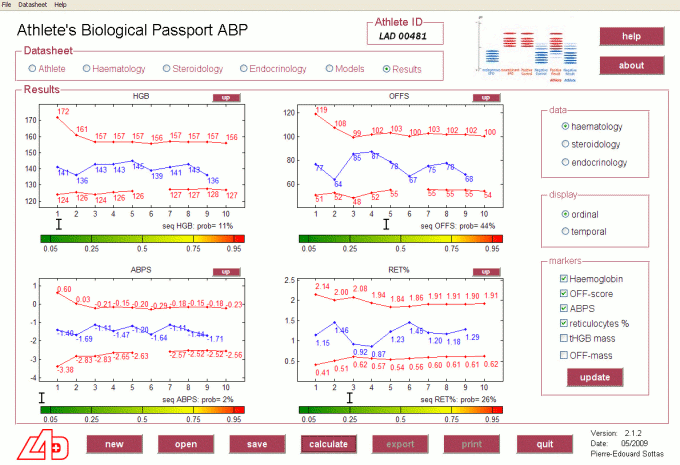
Point 4
MF: Z-score is a number that expresses the probability that the test can not be the result of natural physiological changes (not necessarily doping, in any case).
Z-score is used in the Biological Passport (Haematologica 2006,91:356-363 and UCI Technical Document 2.09), even though, as you say, often it takes a SUBJECTIVE assessment of a "picture of pattern, magnitude of changes and what time they are occurring", which sometimes lends itself to biased interpretations.
MF: Z-score is a number that expresses the probability that the test can not be the result of natural physiological changes (not necessarily doping, in any case).
Z-score is used in the Biological Passport (Haematologica 2006,91:356-363 and UCI Technical Document 2.09), even though, as you say, often it takes a SUBJECTIVE assessment of a "picture of pattern, magnitude of changes and what time they are occurring", which sometimes lends itself to biased interpretations.
RP: The four parameters used in the Biological Passport, as of today, are: Hemoglobin, %reticulocytes, OFF-score and ABPS-score. The passport is not a static tool or threshold based test but rather a continuous assessment of blood parameters that when assessed as a 'whole' can give very clear and objective patterns which may be reflective of blood manipulation. Factors such as competition, altitude, illness/injury, and pathology are always considered, however, before making final recommendations or conclusions about any suspicious profile.
Point 5
MF: See comment to Point 3.
I find it very surprising that such an Expert Scientist as Yourself has expressed an "absolute certainty of blood manipulation" in the evaluation of data of which You had only partial knowledge.
RP: Two points that have not been explained by Ferrari and which would be pivotal in an evaluation of such a profile are:
1. 1) Why had the Hemoglobin and Hematocrit increased during the 2009 Tour race when in just the previous race they had dramatically decreased (by almost 15%). The point here is not the decrease in Hemoglobin during the Giro as this probably reflects hemodilution as pointed out by Ferrari (and was not suggested by me that this was due to blood withdrawal) but rather why the same phenomenom did not occur during the Tour de France.
2)Why were reticulocyte levels decreased when Hemoglobin was increased in the two tests allegedly collected/performed at altitude prior to the 2009 tour. This scenario is consistent with previous administration of stimulating agents such as EPO and or previous blood re-infusion. In the original post “…. from October 16, 2008 the average reticulocyte levels are 1.1 but from May 18, 2009 the average reticulocyte levels are 0.6.’ This change/reduction in reticulocyte production during competition is not due to hemodilution however as percentage values for reticulocytes are not affected by this physiological response. This reduction reflects a blunted response to normal red blood cell production and can be achieved by micro-doping over an extended period of time or blood doping over shorter periods.
Without a satisfactory explanation of these two key points, my suspicion of blood manipulation would remain as my conclusion in the initial biological passport evaluation.
2.
Thursday, September 27, 2012
The Scientists Debate, Round Two, Ferrari Response to Parisotto Rebuttal
Dr. Michele Ferrari has responded to Robin Parisotto's rebuttal HERE.
Monday, September 24, 2012
Behind the Curtain
By Jim Ferstle
Welcome "behind the curtain" of the sports drug testing process. As sports doping has become more sophisticated, the methods used to catch someone who is doping have had to become better as well. In endurance sports, such as distance running and cycling, blood doping, enhancing the blood for a performance gain, has become the "battleground."
How do you tell the difference between when someone is merely training hard, getting proper recovery and diet, or doping? Tests have been developed to detect the use of recombinant erythropoietin(EPO), the use of which had replaced blood doping(removing and reinfusing blood to enhance the oxygen carrying capacity of one's blood.) as the method of choice for endurance athletes.
But those using rhuEPO have discovered a "work around" to minimize the danger of being detected of taking what is called "micro doses," small amounts of rhuEPO. They combine use of the rhuEPO in micro doses with "old fashioned" blood doping--removing one's blood and reinfusing it close to a competition in order to increase your red blood cells/oxygen carrying capacity of the blood.
The reason for going back to "old fashioned" blood doping is that it is much harder to detect, especially when the individual uses his or her own blood. How can you tell if somebody has done a "vampire transfusion"(sucking out one's own blood and putting it back in again)? The answer has been a protocol known as the biological passport. Simply stated the biological passport is a comparative analysis of various blood parameters over time, tracking and the changes and .interpreting what those changes mean.
Detecting use of rhuEPO is a simpler process. Scientists developing the test discovered that the recombinant(synthetic) EPO was different than the EPO produced by one's body. (EPO is the body's natural "trigger" for stimulating the production of new red blood cells--reticulocytes.) Thus, using a process called electrophoresis, synthetic EPO could be differentiated from the EPO everyone produces normally.
So, the "sophisticated dopers," those who didn't merely take a PED(performance enhancing drug/substance), but used every means at their disposal to make sure the substance or method they were using had minimal danger of being detected by the current drug testing protocols. It's been called the "cat and mouse" game, the mouse being that doper and the cat being the anti-doping corps attempting to catch them.
If you've ever watched a cat hunt its prey, you'll notice the cat patiently watching a mouse, a bird, whatever it is after, and studying the patterns, movements of the prey. The anti-doping scientists, to some extent, do the same thing. They compare the physiological profiles of "normal" athletes with that of those who are doped. Patterns emerge. Abnormalities are discovered that allow the scientists to determine whether the individual is doping or not.
For example, the reticulocytes, mentioned above, are more plentiful in the blood of a person who is stressed in such a way that the body compensates by attempting to increase red blood cell production. If you travel to a high altitude, for example, oxygen is less available so the body adapts by producing more red blood cells. You can artificially attempt to do this by getting an injection of rhuEPO, which will quickly increase your red blood cells, but the body also has a feedback mechanism, a governor, that recognizes that this sudden increase in EPO is not part of the regular process.
It is an artificial, short term enhancement that, if continued, will overload the blood with red cells, creating thick blood and potential negative health effects. So the body shuts down its production of reticulocytes to slow the increase in red cells. So, injecting rhuEPO into an otherwise healthy individual leaves a tell-tale indicator of artificial enhancement, a lower retiuculocyte count, fewer young red blood cells. Since red cells stick around in your body for months, you get a mixture of "old" and "new" red cells. This mixture is one of the indicators that someone has artificially attempted to produce more red cells instead of a natural body adaptation of producing a "normal" level of red cells.
This analysis of biological fluids and changes is complex, an interconnected cascade of reactions and substances. Each individual can be different. Thus the data required to differentiate between those who are cheating and those who aren't is not as simple as merely finding a substance, such as rhuEPO, in an athlete's body. What the discussion between the two sports scientists--Robin Parisotto and Michele Ferrari--that we've had here over the last few days is about is the interpretation of biological passport data.
It gives you a peak behind that "curtain" of discussions that go on every time an abnormal profile shows up on doping tests/athletes' biological passports. Recently Mario Zorzoli and his colleagues at UCI(Cyclings world governing body) published a paper that did a similar analysis of some of the cases that UCI has seen using the biological passport. Some athletes were found guilty, others not. The paper illustrated the complexity of the "cat and mouse game," of determining who doped and who didn't.
And none of this addresses the legal issues that come after a scientific panel has ruled that a case they have examined should be prosecuted as a doping violation. This peak behind the curtain is not the final word in this sort of situation, it's merely a peak at how these decisions are made, the arguments that both sides engage in during this process. Why is this important? Because doping is a problem for modern sport. Not just at the elite level, but if you follow news reports of doping, you know that Masters cyclists are using rhuEPO, high school kids are using steroids. A symposium was just held this past weekend in Stockholm tilted: "Doping as a Public Health Issue."
There is a growing number of scientists, ethicists, and sports trend watchers who believe that doping will be the norm for sports in the future. That technology is advancing at such a rapid pace and the will to spend the money necessary to police doping is seemingly not very strong, so sports, especially at the professional level, will be more about entertainment than the games. In the future, they believe, genetically gifted, maybe even engineered, athletes will display their talents for the public's amusement.
Whatever the future, what we can learn from the past is that doping has been largely ignored until recently and has grown as an industry and as a means of achieving success for aspiring athletes. We can sit by and watch as that trend continues or learn about the issue. Peak behind the curtain and see what is happening and learn more about what needs to be done about it. The choice, as always, is yours.
Welcome "behind the curtain" of the sports drug testing process. As sports doping has become more sophisticated, the methods used to catch someone who is doping have had to become better as well. In endurance sports, such as distance running and cycling, blood doping, enhancing the blood for a performance gain, has become the "battleground."
How do you tell the difference between when someone is merely training hard, getting proper recovery and diet, or doping? Tests have been developed to detect the use of recombinant erythropoietin(EPO), the use of which had replaced blood doping(removing and reinfusing blood to enhance the oxygen carrying capacity of one's blood.) as the method of choice for endurance athletes.
But those using rhuEPO have discovered a "work around" to minimize the danger of being detected of taking what is called "micro doses," small amounts of rhuEPO. They combine use of the rhuEPO in micro doses with "old fashioned" blood doping--removing one's blood and reinfusing it close to a competition in order to increase your red blood cells/oxygen carrying capacity of the blood.
The reason for going back to "old fashioned" blood doping is that it is much harder to detect, especially when the individual uses his or her own blood. How can you tell if somebody has done a "vampire transfusion"(sucking out one's own blood and putting it back in again)? The answer has been a protocol known as the biological passport. Simply stated the biological passport is a comparative analysis of various blood parameters over time, tracking and the changes and .interpreting what those changes mean.
Detecting use of rhuEPO is a simpler process. Scientists developing the test discovered that the recombinant(synthetic) EPO was different than the EPO produced by one's body. (EPO is the body's natural "trigger" for stimulating the production of new red blood cells--reticulocytes.) Thus, using a process called electrophoresis, synthetic EPO could be differentiated from the EPO everyone produces normally.
So, the "sophisticated dopers," those who didn't merely take a PED(performance enhancing drug/substance), but used every means at their disposal to make sure the substance or method they were using had minimal danger of being detected by the current drug testing protocols. It's been called the "cat and mouse" game, the mouse being that doper and the cat being the anti-doping corps attempting to catch them.
If you've ever watched a cat hunt its prey, you'll notice the cat patiently watching a mouse, a bird, whatever it is after, and studying the patterns, movements of the prey. The anti-doping scientists, to some extent, do the same thing. They compare the physiological profiles of "normal" athletes with that of those who are doped. Patterns emerge. Abnormalities are discovered that allow the scientists to determine whether the individual is doping or not.
For example, the reticulocytes, mentioned above, are more plentiful in the blood of a person who is stressed in such a way that the body compensates by attempting to increase red blood cell production. If you travel to a high altitude, for example, oxygen is less available so the body adapts by producing more red blood cells. You can artificially attempt to do this by getting an injection of rhuEPO, which will quickly increase your red blood cells, but the body also has a feedback mechanism, a governor, that recognizes that this sudden increase in EPO is not part of the regular process.
It is an artificial, short term enhancement that, if continued, will overload the blood with red cells, creating thick blood and potential negative health effects. So the body shuts down its production of reticulocytes to slow the increase in red cells. So, injecting rhuEPO into an otherwise healthy individual leaves a tell-tale indicator of artificial enhancement, a lower retiuculocyte count, fewer young red blood cells. Since red cells stick around in your body for months, you get a mixture of "old" and "new" red cells. This mixture is one of the indicators that someone has artificially attempted to produce more red cells instead of a natural body adaptation of producing a "normal" level of red cells.
This analysis of biological fluids and changes is complex, an interconnected cascade of reactions and substances. Each individual can be different. Thus the data required to differentiate between those who are cheating and those who aren't is not as simple as merely finding a substance, such as rhuEPO, in an athlete's body. What the discussion between the two sports scientists--Robin Parisotto and Michele Ferrari--that we've had here over the last few days is about is the interpretation of biological passport data.
It gives you a peak behind that "curtain" of discussions that go on every time an abnormal profile shows up on doping tests/athletes' biological passports. Recently Mario Zorzoli and his colleagues at UCI(Cyclings world governing body) published a paper that did a similar analysis of some of the cases that UCI has seen using the biological passport. Some athletes were found guilty, others not. The paper illustrated the complexity of the "cat and mouse game," of determining who doped and who didn't.
And none of this addresses the legal issues that come after a scientific panel has ruled that a case they have examined should be prosecuted as a doping violation. This peak behind the curtain is not the final word in this sort of situation, it's merely a peak at how these decisions are made, the arguments that both sides engage in during this process. Why is this important? Because doping is a problem for modern sport. Not just at the elite level, but if you follow news reports of doping, you know that Masters cyclists are using rhuEPO, high school kids are using steroids. A symposium was just held this past weekend in Stockholm tilted: "Doping as a Public Health Issue."
There is a growing number of scientists, ethicists, and sports trend watchers who believe that doping will be the norm for sports in the future. That technology is advancing at such a rapid pace and the will to spend the money necessary to police doping is seemingly not very strong, so sports, especially at the professional level, will be more about entertainment than the games. In the future, they believe, genetically gifted, maybe even engineered, athletes will display their talents for the public's amusement.
Whatever the future, what we can learn from the past is that doping has been largely ignored until recently and has grown as an industry and as a means of achieving success for aspiring athletes. We can sit by and watch as that trend continues or learn about the issue. Peak behind the curtain and see what is happening and learn more about what needs to be done about it. The choice, as always, is yours.
The Scientists Debate--Rebuttal to Ferrari
By Robin
Parisotto
Point 1
Michele Ferrari: The value of Hemoglobin=13.0 was taken the last day of the Giro,
dated May 31, 2009, preceded by a Hemoglobin=13.6 dated 18/05/2009 and a
Hemoglobin=14.8 at the start of the Italian race (May 7, 2009), a decrease of
12.2% (from 14.8 to 13.0) fully compatible with what is reported in the
literature with regards to cyclists involved in stage races (Int J Sports Med
2009, 30:130-138): Hemoglobin decreases by an average of 11.5% from the
beginning to the end of the event, with individual drops ranging between 7% and
20.5%.
This reduction is mainly due to an increase in PLASMA VOLUME and it is therefore normal for reticulocytes not to have increased...
Robin
Parisotto: It is
interesting that during the Giro there was a volume shift
of 11.5% but not during the Tour, arguably a much more arduous race. In the Tour, Lance Armstrong’s Hemoglobin actually increased from 142 to 145 during the
course of the race. While this represents only a 2% increase, it is a long way from the
11.5 and up to 20% decrease in Hemoglobin, typical of long races as
proclaimed by Ferrari. You cannot have it both ways. Others have also made the
same conclusions.
Point
2
MF: The values of Hemoglobin=16.0 in the samples reported as numbers 14 and 15 were
collected on two consecutive days (June 16, 2009 and June 17, 2009) at
altitude.
RP: From the Cyclingnews article (see below) it is indicated that Armstrong had spent time at
altitude
between the low Hemoglobin
value and the high Hemoglobin values, but it is unknown to me if the tests
(conducted by the UCI) were while he ‘was’ at altitude as Ferrari has
claimed. If these tests were
conducted after returning
from altitude then
they
are comparable to the Hemoglobin value
of 16.1 when Lance Armstrong was
tested at altitude on
August 12, 2009 (I did not have this data point in the data
set
initially evaluated). It would be unusual
for both of the tests in June to have been done while at altitude however. The
Biological Passport is informed by data collected at different times, different
places and different conditions in order to assess any influence that factors
such as altitude exposure could have on the profile. This can only be done if
you have other reference points such as tests performed at or near
sea-level.
According to the
Cycling News article, the blood samples show major fluctuations in his
hematocrit ratio. For example, it said, his hematocrit on May 31 2009, was 38.2%
but 45.7% only a few weeks later, on June 16.
Cycling News
excerpt: It is expected
that Armstrong will challenge this evidence “by summoning medical experts who
may say that a person's hematocrit score could conceivably jump 7.5 percentage
points in 16 days because of external influences like changes in altitude and
heavy perspiration.” For example, he was in Aspen Colorado , USA , at
nearly 8000 feet above sea level
between the two above-mentioned tests.
Point
3
MF: The Athletes Hematological Passport Interpretation Technical Document
(2.09) recommends the adoption of correction factors in Hemoglobin values for athletes who reside in or have stayed at altitude in the two
weeks prior to collection. For altitudes between 2000 and 2500m the correction
factor is 0.8: therefore Hemoglobin=16.0 becomes 15.2. This value is perfectly in line
with the results of the ten samples taken out of competition from October 15, 08
to April 30, 2009, which show an average value of Hb=14.8.
RP: If the values that
were posted on the Lance Armstrong website were those of official tests the correction factor of 0.8 would have been applied if the Doping
Control Form indicated that Lance Armstrong was at or had been at altitude.
Therefore based on Ferrari’s view the actual Hemoglobin value was 16.8 and not
16.0. In any case, if the true (official) Hemoglobin value was 15.2 then surely
Lance Armstrong would have posted that value rather than the higher value. I
cannot think of a reason why an official anti-doping test would consist of ‘two’
results ie. one for the athlete and another for the Passport
evaluation.
Point
4
MF: The same Hemoglobin Z-score for samples 14 and 15 is equal to 0.75,
when altitude is correctly taken into account. I remind you that this parameter
is indicative of suspicion of doping when it is >3.19 (a value that
corresponds to a 99.9% probability).
RP: This is unapplicable information as the Z-score is not utilized in
the Biological Passport. The OFF-score, a formula based on Hemoglobin and
reticulocytes values is used. Irrespective the passport does not just look at a single parameter
and how abnormal it is or not but rather the pattern, the magnitude of changes
of the four parameters involved and at what times they are occurring
(in-competition, out-of-competition or pre-competition). This helps to form a
picture by which an evaluation can be made.
Point 5
MF: The values at altitude of Hemoglobin=16.0 in June 2009 are further confirmed by
the sample taken on 12/08/2009, always collected in Aspen, with Hemoglobin=16.1;
a value that Parisotto refrained from showing, but that can easily be found in
the same source quoted by the Australian author (Cyclingnews.com, July
13, 2012), along with 37 other blood samples reported by USADA.
RP: The data I
referenced did not contain any of this information. As part of the
Biological Passport process this information only becomes available after an
initial evaluation is conducted and where there is suspicion that would require
the availability of such information to help guide a final
conclusion/recommendation. My opinion was formed in the context of an initial
evaluation.
The other point is
that there is no explanation why the reticulocyte values associated with the two
high Hemoglobin values (allegedly due to altitude exposure) have decreased when
the Hemoglobin is increasing. Whether you are at altitude or not if you are
making more Hemoglobin (therefore more red blood cells) then it is intuitive
that you should have more young red blood cells (reticulocytes), not less. I
mean that is the point of altitude exposure in the first place, ie. to
accelerate and increase, NOT decelerate and decrease your red blood cell
production.
Thursday, September 20, 2012
It's All About Blood
By Robin Parisotto
Robin Parisotto is a sports scientist based in Australia. He was part of a group of Australian scientists who helped develop the first blood tests for detecting use of "blood doping" by athletes for the Sydney Olympics in 2000. Currently his input is sought by sports federations on cases of suspected blood manipulation, biological passport abnormalities that, if confirmed, lead to the sanction of athletes for doping violations.
The USADA(United States Anti-Doping Agency) case, where charges were brought against Lance Armstrong, his team manager, and team doctors and advisors has received a lot of attention. Even more since Armstrong decided not to contest those charges before an arbitration panel, stating that he could not get a fair hearing in that forum. The result being that USADA has levied sanctions commensurate with the violations listed in the charge letter.
UCI(cycling's governing body) are waiting for the details of the case file to be submitted to them before any action can be taken on the sanctions proposed by USADA, which include stripping Armstrong of his race results including his seven Tour de France victories from 1999-2005.
The following is an analysis Parisotto did recently using the blood values cyclist Lance Armstrong posted on his website back in 2008-2009 during his comeback to competitive cycling for the 2009 Giro and Tour de France. This was not part of any official investigation into the data, but more as a matter of curiosity about available information on the case and what it can tell us.
Part of USADA’s charge letter that led to the sanctioning of Lance Armstrong(LA) and other "co-conspirators" was that there was strong evidence of blood manipulation(blood doping) in data examined by USADA. I can only presume that some/all of this data included information that Lance Armstrong had posted on a website some time ago where the UCI and USADA were referenced as the testing agencies.
To better understand the basis for charges against Armstrong, it is worth remarking on some of this data. The figures referenced in this article are from Armstrong's published blood values for 2008-2009.
The following graphic indicates a fairly regular and normal pattern of Hemoglobin (Hb) values until a significant drop on May 5, 2009, four days before the start of the Giro d'Italia(the Tour of Italy which was contested from May 9-31, 2009 and where Armstrong placed 12th). This is followed by a quite staggering increase on June 16, 2009 (further explained below), shortly before the Tour de France(which went from July 4, 2009 to July 25, 2009 and Armstrong placed third).
Fig.1 Hemoglobin values for LA October 2008 to July 2009

The graphic below is significant because while Hemoglobin appears to have been significantly disrupted, the reticulocytes (young red blood cells) have suddenly diminished and stabilized just before the Tour de France.
Fig.1 Reticulocyte values for LA October 2008 to July 2009

The charts show a halving of the reticulocyte values in circumstances when the Hemoglobin has risen dramatically, which is not consistent with normal physiology. If one is making more red blood cells and increasing Hemoglobin then it is inconceivable to not have more immature red blood cells (reticulocytes) in the body of a normal healthy person.
The decrease in Hemoglobin from April 30, 2009 to May 31, 2009 (149 – 130) in samples 10 to 13 is 15% however there is no expected increase in reticulocytes. In fact from October 16, 2008 the average reticulocyte levels are 1.1 but from May 18, 2009 the average reticulocyte levels are 0.6.
The sudden increase in Hb from sample May 31, 2009 to June 16, 2009 (130 – 160) in samples 13 to 15 is 23%, however the response in reticulocytes is again not consistent with normal physiology. Such a scenario is consistent with a deceleration in red blood cell production following auto-bleed and re-infusion(i.e. removal of blood to store for later re-infusion, otherwise know as blood doping).
The subsequent low reticulocyte values are consistent with re-infusion of blood and continued micro-doses of rhuEPO(recombinant erythropoietin) to ‘stabilize’ and therefore mask the expected response in reticulocytes.
A Cycling News article of July 13, 2012 noted that if USADA were to present evidence such as this during a legal hearing of the charges, this evidence of doping would be challenged by Armstrong lawyers “by summoning medical experts who would say that a person's hematocrit score could conceivably jump 7.5 percentage points in 16 days because of external influences like changes in altitude and heavy perspiration.” Reportedly Armstrong was in Aspen, Colorado at nearly 8000 feet above sea level between the two above-mentioned tests.
There any number of studies that refute the hypothesis that such a large increase in Hemoglobin is merely a response to altitude exposure.
To suggest that a 23% increase in Hemoglobin and a 50% decrease in
reticulocytes was the result of time spent at altitude is stretching
the bounds of the known and documented physiological responses to
altitude exposure. For example, the Ashenden et al study in 2003
demonstrated that in no less than 7 study groups either at natural or
simulated altitudes (above 2600 metres – about 8500 feet) that even
after 4 weeks of exposure the increase in Hb was, at best, muted.
The
largest increase in Hemoglobin was 9.5% in a group of elite cyclists returning
from living and training in Toluca (Mexico) after 4 weeks. The Hemoglobin measures were taken 7 days after returning to sea level conditions. In
all other study groups there was no increase or at best a 1-2% increase
in Hemoglobin. Similar responses were noted with reticulocyte levels. Whatever way you cut it, Armstrong's blood values are undoubtedly indicative of blood manipulation.
This is hard empirical evidence lending support to the charges filed by USADA. If
this profile had been submitted to me for review by me as a member of
the Passport Panel(biological passports which are used by the UCI,
cycling's governing body, and the IAAF), it would have been assessed
as an anti-doping rule violation particularly in view of the timing of
the disturbances leading into the 2009 Tour.
Subscribe to:
Posts (Atom)