Tuesday, December 16, 2014

Commentary on Bill Miles: How He Taught the Game

Bill Miles and friends watching the NXN Nationals.  Bill's the one with the
beard. Will Leer isn't the only Minnesota guy with facial hair.
Photo supplied by Lance Elliott(last guy on the right)
In 1972 when I moved to Minnesota I was immediately impressed by the running scene.  The comprehensiveness of the community from High School to Masters.  On the High School scene I noted twins from Cretin High School, sort of that time's Hasz twins, but these were guys.  The Roth twins were as successful as Megan and Bethany.  Their coach was a young guy named Bill Miles.

Today Bill Miles retired from coaching at Wayzata High School.  He gathered his team together and told them of his decision.  One of the coaches who was at the NXN Nationals said that Bill was "emotional" about the success of the team, their runner-up finish.  The thought crept into my head: "Is this it?"  Was the 2014 season Miles' swan song? Was he merely waiting until after NXN to tell them the news?

This week I saw the tweet from Wayzata telling the team to come to a meeting today.  I had called Gopher coach Steve Plasencia earlier in the day and when he returned my call he said: "Is it about Bill Miles?"  It wasn't, but my intuition was right for once.  The news had seeped out after Bill told the team.  News travels fast in the social media age. I started to think: What a legacy.  What a commitment to the kids.  To the sport.

The things that came to mind weren't how many championships won or successes, but rather how many lives he has touched.  How many kids who he's helped discover themselves, their talents, their dreams, their path in life.  Coincidentally I happened to be talking with Stillwater's Scott Christensen at this year's MSHSL XC Championships at St. Olaf.  He was talking to Connor Olson's father.  The pair were talking "shop."  Scott said that he hoped that nobody thought that the rivalry between Wayzata and Stillwater was something personal or heated. He relished having the challenge of competing against strong opposition.  It wasn't so much about who won, he said, but rather that they made each other better.

Christensen said he was glad the teams in Minnesota had each other to measure themselves against.  To push each other to new heights.  Wayzata, Stillwater, Edina, Hopkins.  They all wanted to win, but, more importantly, they all helped get the best out of each other.  In today's celebrity culture, it's easy to forget the lessons one learns from sports. As Cannon Falls', now the University of Minnesota Duluth's, Emi Trost had said after winning the MSHSL Class A girls' title last year: "Ten years from now nobody is going to remember who won.  What's important are the relationships, the friendships we've made."

Miles said the same thing in another way at the 2014 MSHSL track championships.  He'd overheard Hopkins' Joe Klecker talking to Chaska's Joey Duerr after the 3200.  Joe was telling Joey, who had been fighting to stay upright down the final straightaway:  "I didn't want to pass you because you looked so bad,"  Miles said Klecker told Duerr.  Not that Joe was worried Joey would run into him, but rather he was concerned with his rival and friend's physical condition.

The next day Klecker would end up splayed out on the track, giving every last ounce of what he had trying to get to the finish first in a battle with Stillwater's Eli Krahn and Richfield's Obsa Ali in the 1600.  These were guys who pushed themselves to the limits, but also had an unspoken bond that went beyond the playing field.  Miles was proud of that character in the athletes he coached and coached against.

Sportswriter Grantland Rice said it best years ago:  “For when the One Great Scorer comes to mark against your name.  He writes - not that you won or lost -But HOW you played the Game."  Bill Miles has played it well.
By Jim Ferstle

Monday, December 15, 2014

News: Chris Daymont; Fayetteville-Manlius' Coach, Bill Aris; Self Propelled Commuting; Cheryl Treworgy; LeMond

Chris Daymont(third from the right) accepting her USTFCCCA Coaches Hall of
Fame Induction trophy

Wall Street Journal article on Fayetteville-Manlius High School's Bill Aris is HERE
.
Ultra runner Ellie Greenwood writes about car-less, "self propelled" commuting HERE.

Long interview with one of the pioneers in women's running, Cheryl Treworgy.  Cheryl spent some time at Hamline in the mid 1970s and is Shalane Flanagan's mom HERE.

Greg LeMond has new book out exploring the science of fitness HERE.
Nick Willis(orange cone pointing at him), Will Leer(bearded again in yellow),
and Kevin Sullivan(#72) on the starting line at the Honolulu Marathon on Sunday.
Willis and Leer had just rescued an injured runner on their way to pace
Sully in the marathon.

Sunday, December 14, 2014

News: HS Rankings; Fatigue; Emily Gordon; Sub 2 Hour Marathon; Willis & Leer to the Rescue; Leer Beard of the Year

MileSplit HS rankings HERE.Click on the boxes at the top for individual and team rankings

Sports scientists attempt to define what causes fatigue HERE.


Sports scientists wagering on whether or not a sub 2 hour marathon will be run by 2019 HERE.


John Cotton Burton, 1923-2014. A Life Well Lived

John Burton's obit takes up nearly an entire column in the Star Tribune this morning.  If one were defined by one's accomplishments then John Burton's legacy is worthy of the man.  Obit is HERE. Separate story is HERE.

Saturday, December 13, 2014

USATF Junior Olympic XC Champs and Footlocker Results; Emma Benner Won JO 17-18, Grace Ping 6th in 11-12 Girls

Facebook photo gallery is HERE. Full results for all the races are HERE.USATF summary of USATF Junior Olympic XC Champs is HERE. Emma Benner won the 17-18 race and Grace Ping was sixth in girls' 11-12 race.

YouTube video of Footlocker races  HERE. Running Times summary of Footlocker Championships with links to full results are HERE. Photo album is HERE.

Grey 7th at USATF Club Nationals XC Championships

A week long bout with the flu didn't stop Team USA Minnesota's Jon Grey. He finished seventh at the USATF Club Nationals XC Meet Saturday in Bethlehem, PA to qualify for the US team that will run in the Bupa Great Edinburgh XC Meet on January 10, 2015.  Grey was only 11 seconds out of first in 29:18 for 10K.  Ryan Hill won the race in 29:07.  Medtronic Twin Cities 2014 men's champ Tyler Pennel was 8th in 29:20.69. Former TCTC runner Joe Moore finished 11th in 29:39.83. Gopher grad John Simons finished 65th in 30:43.76 and was a non scoring member of the team champion Zap Fitness Reebok.  Full men's and women's results are HERE.


Twin Cities Track Club's Kylie Blakeslee was 103rd in 21:56.96 for 6K.  Her teammate Melissa Agnew was 110th in 22:02.99.  Medtronic Twin Cities 2014 champ Esther Erb finished 40th in 20:51.10.  Full men's & women's results are HERE.

Run 'N Fun's Ben Sathre was 52nd in 30:33.30.  Teammate Dan Greeno was 53rd in 30:33.94.  Hamline grad Devin Monson was 80th in 30:57.52, and Run 'N Fun's Mason Frank was 152nd in 31:49.27.


.


Run 'N Fun finishers in the Masters 10K men's race : Jon Keillor 22nd in 33:36.69, Kelly Mortenson 40th in 34:18.75,Gregory Hexum 63rd in 34:52.02, Brent Roeger 77th in 35:14.05, Pat Billig 87th in 35:33.41, Eric Johnson 97th in 35:44.17.  Masters Men results are HERE. Women HERE.

Race highlight videos for Men are HERE Women HERE.


Friday, December 12, 2014

News: Aaron Bartnek; USATF Club & Junior Olympic Nationals Previews, Carrie Tollefson Inducted into Footlocker HOF

Gophers Aaron Bartnek chosen as the 2014 recipient of the Fred O.Watson Award HERE.

USATF Club Nationals preview is HERE. USATF Junior Olympic XC Championship preview is HERE.


Will Leer on the USATF Convention Experience

To those of us out there who give a damn,

Last week (yes, the entire week) was my fourth time attending the USATF Annual Meeting. This year’s edition convened in Anaheim, California, a stones throw from Disneyland. It was five days of endless meetings, post-meeting socials and cocktail hours. Breakfast meetings started at 8:30 am and late-night negotiations would routinely last until bar closing (between 1 and 2 am). If you don’t geek out on track, you were certainly in the minority. Or, rather, you simply were not there. This is our sports yearly Comic-Con where all of the die-hards come out to play.

Now, before delving too deeply into what I am sure lots of you would like to hear, namely the juicy gossip from a bearded attendee, let me share with you the overarching feeling with which I left this years Annual Meeting: Hope. As I traversed the two main conference floors of the Hilton Anaheim, at times literally running between meetings like a crazed Pheidippides, all the while passing likeminded tracksters in the hallways, exchanging frantic text messages, phone calls and high fives, it hit me: our sport is good people. My father, always one to take the opportunity to correct my grammar as a child, will likely cringe as he reads the previous sentence, but I stand by it. 

Those who were not so fortunate as to have their travel, accommodation and/or registration paid for, came to Anaheim on their own dollar, just as they had for meetings in St. Louis, Daytona Beach, and Indianapolis, etc. By a very conservative estimate, attending the Annual Meeting costs $900 per person. And the USATF faithful gladly shell this out year after year. Why? Because they care. Because at the Annual Meeting they have a voice. Or at least they thought they did. And this is why some people are so upset right now. But I will touch on this later. As I said before, I left with the feeling of hope. 

My primary role at the previous two Annual Meetings has been as the Athlete Advisory Committee event leader for the middle distances (800m – 1,500m). This position requires the wearing of many different hats. In any one meeting event leaders fight for athlete’s rights, advocate, negotiate, and vote on rule changes, and lend insight into how funding can be most effectively allocated. We are also there simply to be present and visible. Attendees of the Annual Meeting love to see and hear from athletes. “What matters most to you, the athlete? And how can we help?” a Committee Chairperson might ask. Suddenly all eyes and ears are directed to your response, which promptly becomes item number one on the agenda. In spite of this, every one of our requests/complaints/suggestions isn’t immediately and magically resolved. But it is clear that people care and are there to help, to the best of their abilities. 

For example, here are a few of the positive changes I personally witnessed:
·      As the old adage goes, “better late than never”, Andrew Bumbalough’s disqualification from the 2014 Indoor National Championships was reversed and his 8th place finish was reinstated.
·      The American Record for the 25km distance, previously held by convicted drug cheat, Mohammed Trafeh, was returned to its rightful owner.
·      Sanya Richards-Ross successfully lobbied for the removal of an unnecessary preliminary round in the sprint races should a sufficient number of athletes “scratch” out of competition.
·      The chairs of both the Men’s and Women’s Track and Field agreed to fill the fields of distance races to the best of their abilities. Namely, 24 hours prior to the race start, fields will be filled according to the descending order list.
·      With regards to the overfilled fields at last year’s Indoor Track and Field Championships, it was agreed that a maximum field size would be set for the 1,500m/1-mile and 3,000m finals. In the event more athletes than the selected maximum run the qualifying standard, a “B” final will be run outside the window of time reserved for the television broadcast, wherein the “A” final will be contested.

These may not seem like enormous changes, but to me they illustrate that we still have an organization willing to hear the wishes of its athletes and do its best to help. Keep in mind the above listed items were merely the victories and positive changes I witnessed. I assure you there were many, many more. If there were never any changes, the 500+ people who attend the Annual Meeting each year would not continue to show up.

So now to address what everyone is upset about, namely the board of directors decision to overturn the vote of the constituency to nominate Bob Hersh for the IAAF Council and instead choose current USATF President Stephanie Hightower. If you would like more information as to the specifics of the role of IAAF Council, please read David Greifinger’s opinion piece on trackandfieldnews.com. 

From the outset of the Annual Meeting, the USATF National Office took the strategy of pushing the numbers. From the purely financial side of things, USATF is doing better than we have in decades. Net assets, sponsorship revenue, budgetary expenses, and athlete funding have all increased. Our federation is sitting in the best position it has since I began my career as a post-collegiate athlete seven years ago. This is great news. Ideally, a financially healthy federation means more support to athletes and better results in the major championships. We are, and intend to continue to be, the world’s number one track and field team!

But money doesn’t change everything. In fact, for many (people and corporations alike) having more resources should allow the freedom to focus your attention on becoming better. What better means in this instance, I don’t know. But it certainly is not the back room type dealings we witnessed in Anaheim.

Will Leer wins the Wanamaker Mile at the Millrose Games
In the aftermath of the board’s decision to overturn the nomination of Bob Hersh, USATF’s director of communications, Jill Geer, issued a press release in which she made the bold claim that “very few organizations in our everyday lives are ‘pure democracies.’ ”  While that may very well be true, in our instance democracy counts. Nearly all of the elected positions within USATF are accountable to the membership. And a vote this lopsided (392-70 in favor of Hersh) speaks loudly for the constituency and their collective desire. While the 85% majority vote was indeed in favor of Mr. Hersh, it was equally against current USATF President Stephanie Hightower. I will grant the board that this is an important year at the IAAF with the election of a new President (current President Lamine Diack has held the position since 1999). This should usher in a new era for the IAAF with new leadership and new direction. We need to be prepared for that change, as hard as it may be, and clearly the board decided, by its 11-1 vote, that Mr. Hersh was not amenable to the newly defined role of IAAF council.

This still doesn’t answer the important question “Why?” In her remarks to the floor at the Opening Session, Mrs. Hightower spoke of the need to eliminate the rifts between “us” and move forward together. This decision, without a clear explanation of it’s intent (Hell, just tell me that you think Bob Hersh was doing a crappy job!) does not lead the membership to trust the board. By not explaining their motivations it leads people to believe their actions are more dubious than they truly may be and appear as an effort for the board to procure more power. Like her or not, on her blog asklaurenfleshman.com, Lauren put it quite well:

"I don’t know enough about Stephanie Hightower to know if she would be good at the job or not, or better than Bob, etc. But I do know that at this meeting… she completely disregarded the wishes of the people she is meant to represent… She claims she wants to end divisiveness among us and then leads a huge political power move to get what she wants. How can we expect a person like that to represent us well at the IAAF? How can we trust the board? … I mean, what is really at stake here that’s worth tearing us apart?"

Then again it could be as simple as “Don’t hate the player, hate the game.” As members of the board themselves, Mr. Hirsh and Mrs. Hightower both had the ability to lobby for votes. Clearly Mrs. Hightower did a better job at convincing them she was the better person for the job. If we want to change things of this nature from happening in the future, it is up to us to change the game. 

All of this being said, we may be okay. This whole conversation could end up being for naught. That would be ideal. It remains to be seen whether or not Mrs. Hightower will be accepted in to the IAAF community. After all, politics on their highest level are ridiculous. If that is also the case with the IAAF, then who better to represent us than Mrs. Hightower. At least we know her voice will be heard.

Thursday, December 11, 2014

News: HS Rankings, IOC Plan to Cut Track Events

DyeStat final HS XC team rankings for girls' is HERE, boys' HERE

Mpls Park Board Fees

Interesting City Pages story on Park fees.  Medtronic Twin Cities Marathon pays the most.  Road running events comprise 14 of the 25 on the list. Two triathlons and one walk event.  HERE.

Wednesday, December 10, 2014

News: USATF Club Championships Entry List; Lanin Award to Carrie Tollefson; Academic All Big Ten Awards; Runner Shot; Leer/BOTY

Entry list for USATF Club Championships is HERE.

Carrie Tollefson selected as 2014 recipient of the MDRA's Lanin Distinguished Service Award HERE.

74 Gophers selected  Fall Academic All Big Ten honors HERE  Michigan's Mason Ferlic and Wisconsin's Michael Van Voorhis also selected.

Cautionary tale.  Runner shot by deer hunter HERE.

Will Leer is one of the Sports BOTY (Beard of the Year) nominees for 2014.  Vote HERE.


Tuesday, December 09, 2014

News: Stress Fractures; NSIC AOW; NCAA

Epidemiological study of sports injuries in high school athletes shows that stress fractures are most common among gymnasts and cross country runners.  Further study needed to be able to discover why and what can be done to help prevent stress fractures in these athletes HERE.

MSU Mankato's Myles Hunter and Michael Sandle named NSIC men's indoor track AOW HERE. Women's AOW  HERE

Interesting reaction from NCAA President Mark Emmert to a school dropping their football program.  HERE

Monday, December 08, 2014

News: NCAA AOW; NCAA DII All Americans: NCAA DII Video Recap; RT NXN Photo Album

First indoor season Athletes of the Week(AOW) are HERE.

NCAA DII All Americans list is HERE.

Video recap of DII NCAA Championships HERE.

Running Times NXN Photo Album is HERE.

Interview with the 2014 NIRCA XC Women's Champion Cara Donohoe


Cara Donohoe finishing first at the NIRCA XC Championships
The Minnesota grad student led from start to finish on the mostly flat 6K course building a seemingly safe gap on a  pack of  eight runners. It wasn't until the final stretch that  Illinois’ Emma Grimes broke from the chase group and made the finish unexpectedly close. 

Donohue, the 2013 runner-up and overwhelming pre-race favorite, won with a time of  22:24. Grimes finished in 22:29. Below Donohoe talks about the race, her approach to competitive running, and her plans for the future.

Down the Backstretch:  How did you approach this year’s NIRCA XC Championships?  It was your last collegiate XC race.  Since you were second last year did you think about winning or just developing a race plan and hope for the best?

Cara Donohoe: My strategy for most races is to think about another person or a cause that I want to run my race for.  While it’s exciting to race well and to win or PR, there is always at least one point during races that I want to give up.  I find that I am much more motivated to press on during the race for someone or something outside of myself.  

For instance, one race this season, I decided to run for one of the patients I have been working with at the VA Medical Center that has been inspirational to me.  Having said that, winning NIRCA Nationals has been in the back of my mind since last year when I came in second place.  Over the years, I have gradually increased my confidence in my ability to run my race and my intent was on winning this year.

DtB:  You said it felt good to end your collegiate career “on a high note.”  When did you realize you were going to win it?  What were the feelings afterward?  Big celebration or just another race?

CD: While I haven’t had an especially long racing career, I have had some disappointing seasons due to injury and anemia, which greatly effected my racing capabilities.  Being able to run healthy and calm is one of the best feelings.  

For both regions and nationals this year, I raced alone for the majority of the race, which presents its own challenges.  While I knew I had a significant lead, I wasn’t sure if I had won until I hit the final straightaway of the race toward the finish line.  As soon as I hit that point, I couldn’t help but smile.  Seeing my teammates and strangers lining the course and cheering for me was like nothing I have ever experienced.  It was one of those moments I wish I could capture in time, because it was an extraordinary feeling.  

After the race, I felt a mix of emotions- relief, joy, excitement, shock.  The best part was seeing my teammates’ and coach’s reactions afterward.  I was happy to have made them so proud, and I couldn’t wait to call my parents and family to let them know how I did.  They are my biggest fans and support, and I knew they were anxiously waiting to hear how the race went.

DtB:  What are your plans for track season? 

CD: I plan to continue to race with The Minnesota Running Club for indoor and outdoor track season this year.  I’m a little less experienced with track, as last year was my first year running track races.  We tend to stay in the Midwest for traveling during track season.

DtB:  What are your plans after you graduate?  Any job prospects yet? 

CD: I’ll be finishing up my Master’s for Speech Language Pathology this coming May.  I am currently doing a traineeship at the Minneapolis VA Medical Center where I have the privilege of working with the unique population of veterans while providing assessment and treatment for various communication disorders including TBI, dysphagia, voice disorders, cognitive impairment, aphasia, spinal cord injury, head and neck cancer, and those using AAC.  

I truly enjoy being in this setting, and hope to work in a hospital or VA Medical Center somewhere following graduation.  I am just starting to apply for jobs now.  While I would like to stay in Minneapolis following graduation, I am open to moving to another state if it’s necessary for the job I want. 

DtB: You said last year that you’d like to continue your competitive running wherever you end up?  Is that still the plan?  If so, how do you see that fitting into life in the “real world?”

CD: I do plan to continue running competitively in the future.  This year was the first year that I felt comfortable, confident, and calmer racing, which made it a much more enjoyable experience.  I have always been a competitive person, I love the comradery of racing with a team, and being a part of the running community in general.  

Many of my life plans are up in the air right now, but wherever I end up, I plan to join a running club.  Throughout my undergraduate and graduate school education, I have been extremely busy and involved in a variety of things.  I have always still been able to find time for running.  It’s about prioritizing things and working to find balance in life.  While I know I will still be busy following graduation once I enter the “real world”, I know I can still find time for running with some planning and prioritizing. 

DtB: You noted that you were still a “relatively inexperienced runner.”  What have you learned about yourself, about running now that you have another year of experience?

CD: One of the things I have realized about myself is that I’m a little non-traditional as far as training goes for runners.  The majority of my workouts this season, I did based on time and how I felt (tempo runs and hills versus mile repeats, etc.).  

I found that I was faster and more rested physically and mentally this season rather than burned out as a result.  In addition to this, I backed off on my weekly running mileage and increased my cross training this year, which seemed to help my performance and reduce my injuries.  I have also learned the importance of mental preparation for racing.  

Like I mentioned previously, I always choose a person or a cause to race for, which greatly inspires me and motivates me during races.  I also tend to briefly visualize how the race will go in my head while I’m warming up.  Lastly, I often choose a Bible verse to think about during the race and always say a short prayer before I’m at the start line.   

DtB:  Are there any experiences involving running that stick out, that are more memorable than others?

One of the experiences that sticks out most to me from running was during my last year of undergrad at the U of MN.  I was racing the NIRCA Regional Meet in Ames, IA and my entire immediate family, and many members of my extended family were there.  My racing season had been disappointing for me that year, and this race was similar.  

I had extreme anemia that season, but I was unaware of it at the time.  I eventually ended up having to get an iron infusion to restore my physical health. I remember my family members cheering for me all over the course during this race, and that my breathing became so labored I wasn’t sure I would be able to finish. 

 It was a humbling experience for me that year, as I raced minutes slower than usual and struggled to just finish races.  While this was a low point in my racing career, I vividly remember my teammates and family being supportive of me during this race and after.  It was a moment where I realized that my performance racing didn’t ultimately matter to them.  While they hope that I do well since it’s important to me, they love me completely just the way I am- whether I race fast or slow. 

DtB:  You also said that you enjoy working with kids.  Are there potential opportunities there?

CD: I do greatly enjoy working with kids.  I have working with kids both clinically as a Speech Language Pathology Graduate student clinician, and in the Fluency Lab and Learning to Talk Lab at the University of Minnesota.  I’m uncertain if I will work with kids as a Speech Language Pathologist initially, since I have appreciated working with adults at the VA Medical Center this year and hope to pursue a similar career next year.  However, I have an interest in coaching middle or high school kids for track and cross-country in the future.  I am also interested in volunteering with the organization Girls on the Run. 

DtB:  Any more trips, like the one to South Africa?  Any planned for the future?

CD: While there are no current trips planned to South Africa or elsewhere, I do plan to go on more trips like this in the future.  My heart’s desire is to return to South Africa and to travel to other countries as well.  Traveling to South Africa a few years ago greatly impacted my life and shaped how I view things today.  Following graduation, I hope to investigate and plan another trip soon.  

DtB:  Don’t know if you’ve been following the career of Annie Bersagel, who won the Medtronic Twin Cities Marathon in 2013 and also works full time in Norway while she’s training to compete in the Olympic trials.  Any aspirations for a busy life like that?

CD: It’s so inspiring to hear stories of other successful runners who lead busy lives! I plan to have a busy life now and in the future.  I have always had a variety of passions and interests, and I plan to continue to pursue them following graduation.  

Currently, I am taking classes and studying for our graduate school comprehensive exam, working at the VA Medical Center part time as a clinician, working in two research labs at the U of MN, teaching yoga sculpt and cycling classes at CorePower Yoga, running with the U of MN running club, and staying involved at my church, Hope Community Church.  

I plan to stay involved with many of these activities following graduation and to start volunteering more in the community again with organizations such as Girls on the Run and Breaking Free.  At some point, I also hope to find balance with my busy life and a family of my own.  In the meantime, I look forward to the challenge of finding new balance and rhythm with my life next year with all of the changes I will undergo in the next few months.


Sunday, December 07, 2014

Kraig Lungstrom's and Lance Elliiott's NXN Photo Albums

Kraig Lungstrom's NXN Photo album is HERE. Lance Elliott's is HERE

NXN: Hunting for the Red Jerseys

For Wayzata's Jared Carpenter the mission on Saturday at the NXN XC Nationals was simple: "Manlius was in red," said Carpenter. "The mission was to keep them in sight." Once they were in sight the job became to hunt them down and pass them.

Carpenter and 2014 Minnesota State High School cross country champion Connor Olson both saw the foursome in red in front of them.  They ran them down and finished in front of all the red jerseys to help the team vault into second place.  Teammate Ian Eklin joined the duo by hunting down all but the top three of the Manlius men, two of whom finished only a second in front of him.

Wayzata boys with their trophy.
Photo by Kraig Lungstrom
Statistically the difference between the two team was not much.  Manlius averaged 16:03 per scorer, Wayzata 16:06.  The spread between their top five finishers was 49 seconds for Manlius, 56 for Wayzata.  The biggest difference between the two teams was that Manlius stayed with their tried and tested race tactic of going out hard and hanging on.  Wayzata's Kraig Lundstrom, the team's post season coach, advised them not to "go out too hard."

The slippery footing, the hills favored strength runners, smart runners, those who could manage their effort and apportion it as needed throughout the race.  Alas the "hare" beat the "tortoise" on this occasion, but not by much.  Hopkins' Joe Klecker, whose style mirrors Manlius', was not so fortunate. "At the beginning I got out too slow, said Klecker, who estimates he was in 15th or 20th at a mile and a half in close proximity to the leaders, but not in the front pack.

"I probably worked too hard, too fast," in an effort to attempt to get to the front," he said.  "I probably needed more patience."  For Nick Wareham the race was also a valuable tutorial on racing against national level competition.  The race "was definitely one of the toughest I've ever run.  Very competitive conditions.  I've never dealt with that before, but I imagine it's what it's like at top level NCAA meets."

Wareham was informed late that he had a spot in the field as he was on the bubble for an at-large spot, so he hadn't prepared as he might have had he known he was going to be able to race NXN earlier.  But that really wasn't much of a factor, he said.  "I wanted to get out quicker than I did, but it felt like a sprint...I was back in around 40th and I was hoping to get into the top 30. I tried to work my way up."
Wareham finished 37th.

For Edina's team, the goal was to get in the top ten."The main thing was not to do anything different," said Lance Elliott, a top Minnesota Masters runner as well as the team's post season coach.  "I ran with them every day.  A couple of them were struggling with nagging injuries, but that all worked out.  The weather was not in our favor.  Last year we were able to train on the track and on the trails.  This year it got cold really quick and there wasn't many clear roads.

"We had to go indoors under the dome.  We ran some 1000 repeats on the West River Road.  We were ready for the race.  The plan was to get out at a moderate pace and pick off runners as the race went on.  I was watching the race from the top of the last two uphills (that were right before the finish straight).  I saw runners pass ten people on that short stretch.  If you had your legs at that point, you could really make up a lot of ground."

"We decided to be smart," said Logan Ramlet, the team's top finisher who was 60th in 16:13.  Not get caught up in any single element of the race, the course, or the competition.  "It worked out really well," Ramlet said. Another thing that appeared to work out well was the course.  Coaches and athletes described the change as a big plus for the event, that it was a "true cross country course."

"The main idea," said Carpenter, who could have been speaking for any of the Minnesotans running on Saturday.  "was to have a good time.  Have a blast." They succeeded.

News: USATF MN All Comers; Justin Grunewald Wins Cayman Islands Marathon; Cal International Marathon; NCAA DII Summary

Results from USATF Minnesota's All Comers meet are HERE.

Justin Grunewald wins the Cayman Islands Marathon HERE.  Justin holds the marathon course record and Gabe Grunewald the women's half marathon record HERE. Marathon results are HERE.

Lisa Baumert finished 26th at the California International Marathon in 2:43:38, just missing the US Olympic Trials B standard of 2:43:00. Laura Paulsen, who spent some time in Minnesota as a Senior Innovation Fellow at the U of M Medical Devices Center,  ran 2:39.54 and was the 12th female finisher.  Sandra McClellan was 30th in 2:45:31.  Stephanie Price was 55th in 2:52:25.  Marissa Lindsay finished 77th in 2:58:30.

For the men, Eric Loeffler was 18th in 2:18:18, just short of the men's B standard of 2:18:00.  Donnie Fellows was 22nd in 2:19:47.  Jake Marotz 23rd in 2:20:16.  Ben Schneider was 35th in 2:25:34, and Daniel Ducharme 69th in 2:33:16

Results are HERE.

USTFCCCA summary of the NCAA DII races HERE.

UMD's "fun in the mud" video HERE.

NXN: Manlius Wins the Title, Minnesotans Continue to Impress


The Wayzata and Willmar girls pose for a group photo.

While Manlius ran off with the top trophies, the consensus among the Minnesota contingent at NXN XC Nationals in Portland was that all the Minnesota teams and individuals demonstrated the quality of high school cross country running in the state.

For the girl's teams this year's race was their apprenticeship. Unlike last year when a veteran Wayzata team halted Manlius' almost total domination of the race, this year both Wayazata and Willmar were young teams where most if not all of the teams' runners were newbies to the NXN experience.  Jerry Popp, the Willmar team's regular season coach, had noted in prior interviews during the cross country season that the Willmar girls team had not even won a meet in seven years until three years ago.

At NXN they finished fourteenth in the US.  Tara Bernhagen took the team through the transition from the "regular season" through the "playoffs," and nationals.  And, as in the Minnesota HS season, the team ran as a tight pack and had "interchangeable parts."  If one team member was having a bad day, another stepped up to fill the void during the season, said Popp.  At NXN, it happened again as the team's top finisher was eighth grader Serena Monson and the team's leader throughout the season, senior Samantha Hanson was the fifth scorer.

Hanson said in a pre-race interview: "We just want to have fun and do our best.  We really don't know what we can do yet."  They were aiming to be somewhere in the top 15.  The difference between their pack and Manlius' was how fast the first runner in their respective packs ran, as the others would follow in a tight group.

It was a year where the individual entrants dominated the field.  Nineteen of  the top twenty finishers were individual qualifiers.  Thirty-five of the top 46 finishers were individual qualifiers.  Manlius' leader of their pack, Olivia Ryan, finished forty sixth, followed within eleven seconds by all five of the team's scorers.  Willmar's spread between their first and fifth finishers was nine seconds. Munson placed 108th.  Hanson was 118th.

Manlius' pack of five averaged 18:40 per runner.  Willmar 19:24.  Wayzata, whose pack of seven last year was just as tight at Manlius and Willmar this year, but was more spread out in 2014.  A minute and twenty-three seconds separated Anna French, who finished thirty-fourth, and the team's fifth scorer Samantha Lettenberger was 148th, three spots in front of Manlius' seventh runner.

Both Willmar and Wayzata's girls got out slow.  Willmar's slow start was in part due to their start position near the left side of the course, where the first turn nearly 400 meters into the race pinched those who didn't rocket off the starting line.  Wayzata's girls were impeded by runners in front who slowed to avoid mushy parts of the course.

The Wayzata girls "got off the line pretty poorly," said Jake Hallen, their coach for the post season.  As a result, Hallen said, they had to battle the rest of the race playing catch up.  French had only worked her way up to fiftieth with less than a mile to go, said Hallen, and she rallied to pass sixteen runners by the finish. French, who finished eighth last year "was having an off day," said Hallen.  But, instead of giving up, Hallen added, French adjusted her goals and finished as fast as she could for the team.

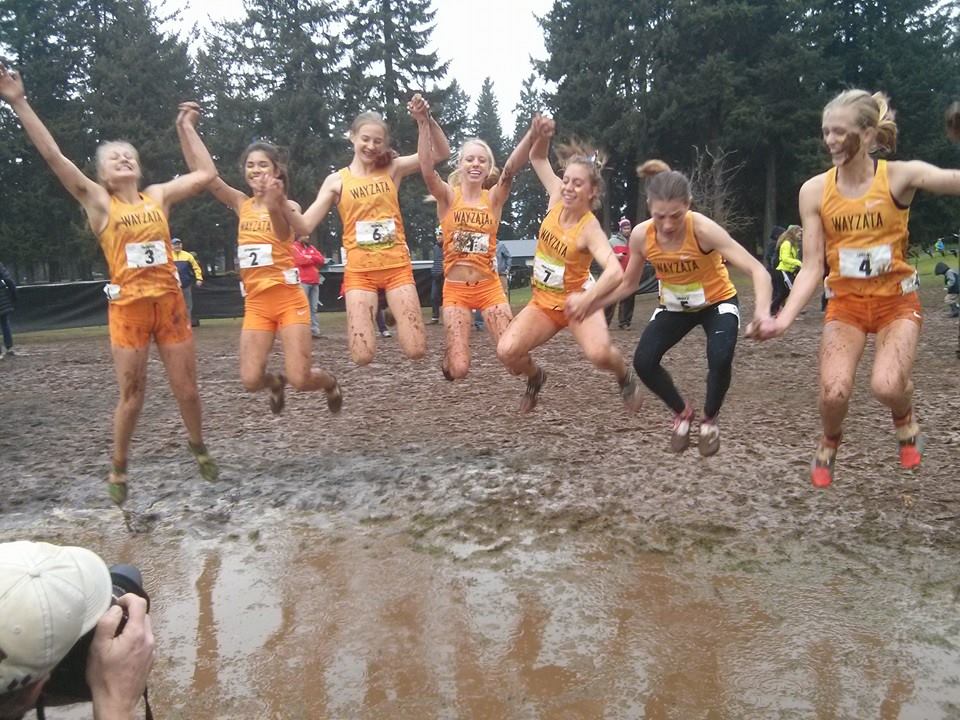
"I think they learned a lot," said Hallen, who was sitting near the Manlius coach Bill Aris on the bus drive back to the hotel.  He overheard Aris tell one of the other coaches: "The next season just started." Mission accomplished. Time to get ready for next year.  "Five of our runners said: 'We've got a Nordic(XC Ski) race this week.'"  said Hallen. After the race the Wayzata girls did a promo jump in a puddle of muddy water for one of the online running video sites and got into an impromptu "mud fight" with Davis, a team from Utah.  "We won that," said Hallen laughing.  "So we came away with one win this weekend."

In a deep field of top individual runners Alexandria/Jefferson's twins Megan and Bethany Hasz continued to move up the field.  Having finished thirteenth(Bethany)  and fifty-third(Megan) last year, the first year the juniors had run together at NXN, the pair used their experience and patience to climb to fifth(Megan) and ninth(Bethany). The pair had been up with the leaders at the mile, but when the lead pack broke away in the second mile, the Hasz twins didn't try to cover the move.

They slipped back to around fifteenth, but that slide didn't last long as they soon launched their drive for the finish picking off runners who had pushed too hard, too early.  Instead of keying off the field, they keyed off each other to successfully climb into the top ten.  It was a year of change for the twins. They changed high schools and coaches, though their new coach had coached them in junior high so it wasn't a tough transition.  the one constant was their routine.  They train together and race together, and that experience served them well in the middle of the race when they made the decision to be patient and wait until starting their drive for the finish.

Minnesota was well represented in both the individual and team races with only two seniors in the team and individual competition.  The State continues to make its mark at NXN and the stiff competition to even qualify for the event signals that Minnesota's impact on the event will continue to be significant in years to come.

Saturday, December 06, 2014

News: NCAA DII Photo Album; Chuck Peterson Open Results:;St. Scholastica Opener Indoor Track; SDSU Open; Bumbalough

USTFCCCA's Kyle Terwiliger's NCAA DII photo album is HERE

MSU Mankato summary and compete results for the Chuck Peterson Open are HERE.

Results from the Opener indoor track meet at St. Scholastica are HERE. UMD men's summary HERE, St Scholastica's women's summary is HERE, men HERE.

Dakota Duals results are HERE.

Results from the SDSU Open are HERE.

Wall Street Journal report on reinstatement of Andrew Bumbalough is HERE.


NCAA & NXN: The Men's Side: Augustana Third in NCAA DII; Wayzata Boys Second at NXN

NSIC champion Augustana matched UMD's third place finish in the men's team race.  Full results are HERE. Augustana summary is HERE. NSIC Summary is HERE
Augustana men's team

Official results in Wayzata second in the teams with 159 points.  Manlius sweeps the titles with 111. points. Edina finishes ninth. Nick Wareham was 37th in 16:00; Joe Klecker 47th in 16:05. Wayzata boys' interview with MileSplit is HERE.
Wayzata and Manlius on the Podium

Full results are HERE.
Wayzata boy's and girl's teams

NXN & NCAA Women's: Race for the Mudders: UMD third in NCAA DII, Wayzata Sixth at NXN

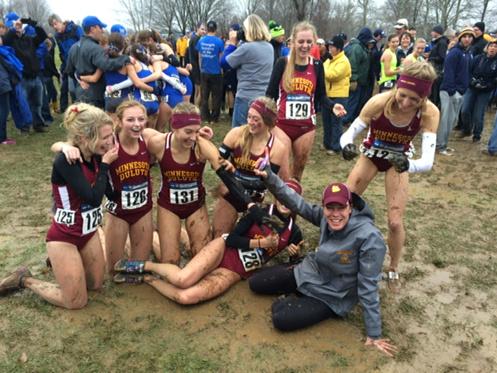
UMD celebrate their third place finish.
Both women's races will go off at about the same time, and one other thing is in sync--rain soaked courses.  In Louisville for the NCAA DII nationals, there appears to be bigger puddles.  In Portland at NXN, the Nike staff has been working on the low point of the course to get rid of the visible moisture that comes at the 1K and 4K mark of the race.

The new course for NXN has received a lot of enthusiasm from the coaches and has been labeled "fair," and a "strength runners' course" by Toni Reavis, who is doing the commentary for the webcast.  Jacob Hallen and Jamie Testa, two former Wayzata runners, who are coaching the defending champion Wayzata girls' team, said that the team is looking forward to the challenge.  It's a different team than last year, said Hallen, and their approach is not to get caught up in the fact that they are defending champions.  That it's just another race.

Willmar's girls have a similar approach, and since it is their first trip to NXN, Samantha Hanson from Willmar said that they "Just want to have fun."  Absorb the experience.  Elliott Heath, Winona grad, is doing the on the course commentary, riding in the "gator(golf cart)" in front of the race. The weather has temperatures in the high 40s, low 50s with a variable wind.

Mud Leap!!!
The Hasz twins both finished in the top ten.  Meghan Hasz finishing fifth in 17:39.74. Bethany was ninth in 17:41.10.  Wayzata girls finished sixth with 240 points.  Manlius won the team title for the eighth time with 70 points.  Willmar was fourteenth with 342 points.  Full girls results are HERE. MileSplit interview with the Hasz twins is HERE.
UMD women on the awards stand.


At the NCAA DII UMD finished third in the women's team race with four All Americans.  Sam Rivard was the first Bulldog across the line in fourteenth in 21:38 with Emi Trost eighteenth in 21:42.3.  U-Mary's Alexis Zeis was 21st in 21:49.3. NCAA results are HERE. Winona State 17th in team race. UMD summary is HERE.  Winona State summary is HERE. NSIC Summary is HERE.
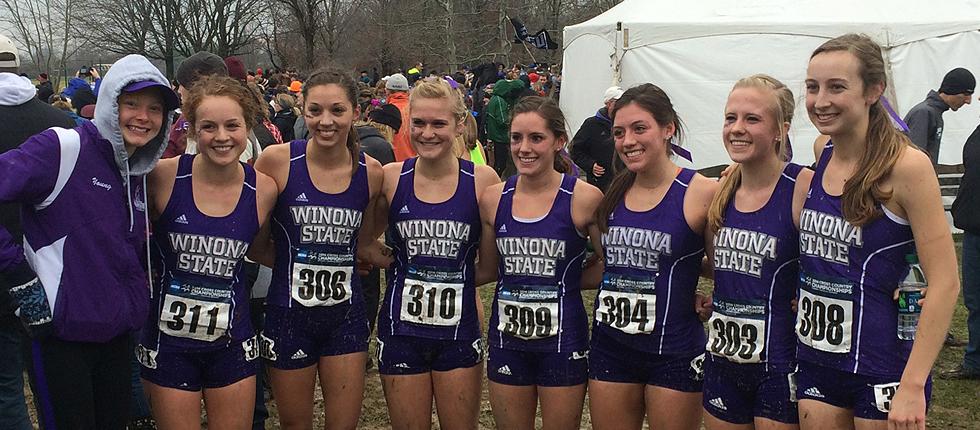
Winona State 17th in DIII team race.

Friday, December 05, 2014

NXN: Picture Album

NXN pre-race picture album by Lance Elliiott HERE (Click on NXN square photo in the upper left hand corner of the page.

NXN: Condition of the Course

By Eric Jahn
A few of the coaches were talking about the run-through and thought that some items were worth noting:


  • Light rain has left most of the course soft-to-mushy.
  • It may rain more tonight and until mid-morning.
  • Athletes were kept off the running surface itself, and they ran on the path parallel to it that will be used by the gator tomorrow.
  • There is a mud pit that has formed just past the 1 K mark that was getting some major attention this afternoon with squeegees and maybe some sand.(Photos 4 and 5 on the RT link)
  • Team camps are set up inside a large maintenance structure, with new carpet and temperature about 60 degrees.(Photo 3 on the RT link)
  • Lanes - Wayzata boys and girls both have lane 23, which is about 3/4 of the way to the outside of the first hard turn to the left, about 370 m into the race.    Seems ideal.  Edina boys and Willmar girls are in lane 4, near the left (inside) edge.  Edina doesn't mind, given their racing style.(Photo 1 on the RT link)
For photos of the course including the start, the inside of the "team camp" where the runners are housed before and after the race, as well as the "mud pit," Go to the Running Times photos posted on their site  HERE.

NXN Pre-race Interviews, Course Preview; Projections and Rankings; Webcast


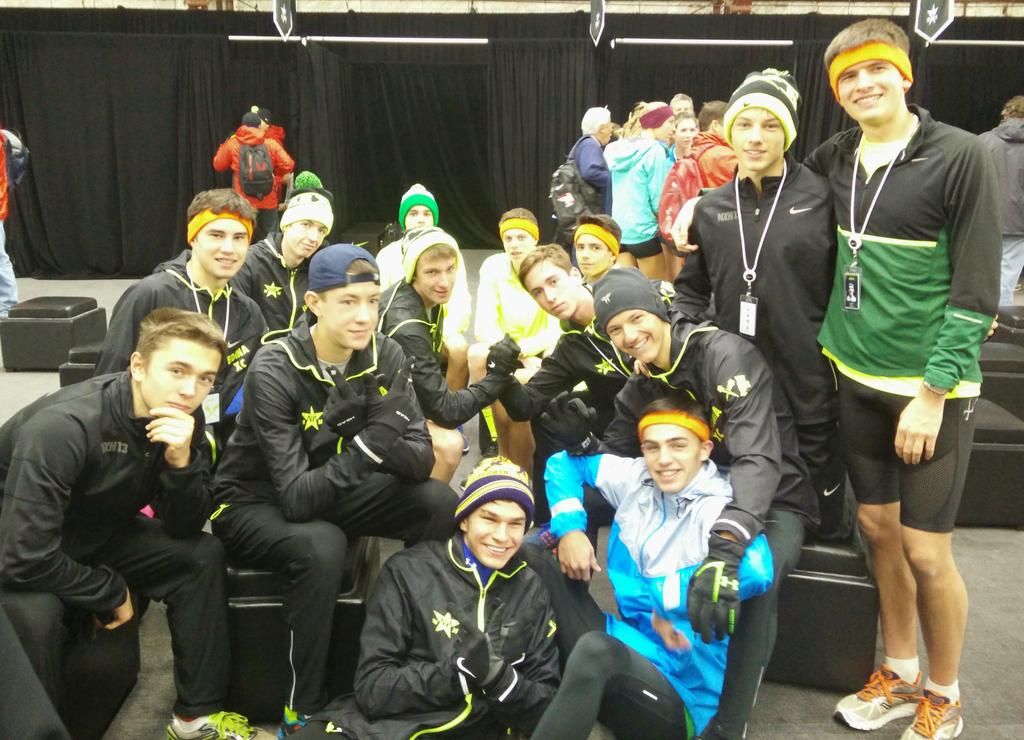
Edina boy's at NXN. Photo by Lance Elliott
Dyestat, Runner's Space, MileSplit interviews with the Megan and Bethany Hasz  HERE and HERE. The Wayzata boys team interview is HERE. Edina boys' team interview is HERE. Wayzata girls' team interview HERE. Willmar girls' team interview is HERE. Joe Klecker interview HERE.

Running Times course preview(eight photos) is HERE. Rankings are HERE(girls') and HERE(boys')

Dyestat's team and individual rankings page is HERE.  Team "projections" are HERE.

Live Webcast of the races starts at 11:30 CST on Saturday with the first race at 12:05. More info HERE.

Thursday, December 04, 2014

News: NSIC; Chris Reed; NXN Preview; Brian Anderson; Beer Mile; NPR coverage of the MSHSL Transgender Policy


NSIC indoor track coaches preseason poll for teams, Athletes of the Year is HERE.  Radio interview with MSU's Chris Reed on football is(starts 7:30 in the program, goes to 17:30) HERE.

Running Times NXN preview is HERE.


St. Thomas'  Brian Anderson selected as a recipient of the NCAA DIII Elite 89 Award  HERE.

NPR coverage of the Beer Mile HERE. FloTrack interview with Elizabeth Herndon, former TCTC member, new WR holder for women's Beer Mile HERE.

Increased prize money for US Olympic Trials Marathon HERE.

MSHSL approves Transgender policy HERE.

Commentary: It's All About Trust

Courtesy of Clipart Panda
The latest doping scandal is grabbing headlines all over the world.  The German network ARD broadcast an hour long documentary on alleged corruption, bribes, doping, and cover ups in Russia.  Just as in the major political scandals it's not the crime but the cover up that is the core of this story.

It's all about trust.  For the anti-doping system to work, all involved have to trust that the system does what it is supposed to do.  That athletes and their enablers who cheat through doping are subject to the same laws, oversight, testing, and sanctions.  That the alphabet agencies that oversee the anti-doping process are treating every case the same, fairly, transparently, and according to the legislation in place to police doping in sport.

The major failure in the system highlighted by the German expose is the alleged collusion to protect certain athletes from punishment for doping.  In effect those who were supposed to enforce the rules became doping enablers.  This is not new, back when I first started covering the issue of doping in sport in 1987 the same flaw plagued the sporting world.  Those in charge of the various international and national sporting federations were lax in their enforcement of the rules.

Doriane Lambelet Coleman, a middle distance runner and lawyer who, along with Edwin Moses and Harvey Glance, attempted to rewrite the rules for anti-doping for the US track & field federation, now called USATF, said that the rules on the books in the early 1990s "looked like they were written by someone who didn't want to catch anybody."  There were huge loopholes, many ways to cover up positive tests, and/or allow athletes who cheated and were caught to get away with it.

The US was not alone in this doper protectionism.  The shared feeling among the sports "super powers" was that the other countries were doing it, so we have to do it.  Dr. Don Catlin, who was a pioneer in drug testing within the IOC and the US compared the situation to nuclear disarmament.  Neither side in this "war" was willing to "demilitarize," take away one of their most potent weapons, doping, because the other side would "win."

There was no belief that athletes who didn't dope could or would be able to compete with those who did.  And no trust that those who were caught by the meager drug testing program in place at the time would be punished.  As doping scandals kept erupting, the IOC knew it had to act to protect their "brand."  The anti doping system was polarized.  The labs would get positive tests only to see the athlete whose sample they tested continuing to compete and win medals in international competition.

Some of these cover ups were eventually exposed.  The scandals generated enough momentum that the IOC was forced to act.  They created WADA as an independent oversight agency charged with policing the drug testing system that, at that time didn't exist.  Over the years more alphabet groups were formed within nations to act as independent testing and enforcement agencies.  To take the countries' sports federations self interest in attempting to win medals and championships out of the doping business.  USADA, UKAD, ASADA, and all the other domestic anti-doping agencies were created to police doping in sport.

Over that time, roughly about 20 years, trust has been established that within countries with functioning agencies would not "look the other way" when that country's star athlete was busted for doping.  Athletes who doped could no longer count on sports administrators making their doping offenses "go away." The biggest problem that remained was that not every sports power had a functioning anti-doping agency.  Third World countries, such as Kenya or Ethiopia, that dominated segments of sport, such as distance running, still do not have such agencies.

So rumors and innuendo continued among athletes that the African athletes' success was due to the inability of the IAAF, the international federation charged with overseeing, promoting, growing the sport, to bring the various countries in line with the WADA Code that attempts to "harmonize" the anti-doping system.  To make sure that each country has, at the very least, an independent doping deterrent in place.  As the other current doping scandal has exposed, Kenya is not immune from the spread of doping, but in a relatively short period of time, some progress has been made in this area.

The World Marathon Majors, a coalition of major marathons throughout the world, has funded some testing in an attempt to do what the various countries and sports federations have not been able to do, provide out of competition testing in areas with no operating anti-doping agency in place to deter athletes from doping.  That the WMM has had to do this is indicative of the lack of adequate funding for the entire anti-doping industry.  When Paula Radcliffe was asked what she would do if she were in charge of the anti-doping program for the IAAF she responded that she'd triple the IAAF's anti-doping budget.

The old investigative mantra of "follow the money" as a tool for examining institutional or individual shortcomings is apropos of one of the major weaknesses of the current anti-doping system.  Chuck Yesalis, who has followed the ups and downs of the anti-doping movement over decades, has said that in the fight to minimize doping in sport the anti-doping forces are fighting a war where the other side has guns and they have pea shooters.

The most important asset for the anti-doping movement, however, is something money can't buy.  It's trust.  Trust from the public that what they are watching is not a drug riddled circus.  Trust that anti-doping agencies cannot be bought or influenced to "look the other way" because a highly marketable athlete is caught doping.  Trust that the sports federations and other groups with influence over the athletes are doing their jobs in policing doping, enforcing the rules.

Thus the current revelations about what has alleged to have been going on in Russia go to the core of the doping problem.  They undermine the trust within the athletic community that all that can be done is being done to protect clean athletes, enabling athletes to compete on equal footing, not having to worry that the athlete next to them on the starting line is pharmacologically enhanced. The anti-doping system cannot function properly without that trust.

When Ben Johnson was caught doping in 1988, Catlin thought this would demonstrate that the testing system was one all athletes could trust.  That the fact that the most marketable athlete in the then most marketable sport in the Olympic Games was busted for doping would turn the tide in the anti-doping battle.  Instead, shortly after Ben was busted a mother and her son came into a pediatrician's office in the Twin Cities and asked the doctor to prescribe for her son some steroids so he could be a better wrestler. This was not an isolated incident.  At least one message delivered by the Seoul Olympic bust was that "steroids work."

There were minimal disincentives to dope back then.  There was no WADA.  no USADA, and now that RUSADA, the Russian anti-doping agency, is implicated in the allegations swirling around the doping scandal in Russia, the anti-doping efforts will take a hit.  Some trust will be lost.  The challenge is to reestablish that trust. Without it the athletes will still be tempted to take "short cuts," to dope.  There will continue to be doping scandals.  There will continue to be parents who want the "magic potions" for their kids, and sport as we know it could morph into a modern day gladiator fest.  "Entertainment" that attracts paying audiences rather than one that celebrates and showcases athletic skills.

Athletics could become a freak show of doped up individuals, replaceable parts in a traveling roadshow, a circus of sports that makes money for the owners and operators of the franchises, but treats "athletes" like indentured servants.  Is this rather dystopian vision what we want our sports to become?
--by Jim Ferstle


Wednesday, December 03, 2014

NXN Course Challenging

Map of the three loop course.  Map courtesy of Nike
Wayzata's Eric Jahn, himself still an active runner with plenty of cross country races under his belt, did some recon on the NXN course this year and what he found was an "old school" cross country course that is a "thinking man's"(or woman's) circuit.  Jahn walked the course on Wednesday and described it as quite scenic on an "old, old golf course with towering Douglas Firs."  It's going to be "very challenging" both mentally and physically for the runners, Jahn added.

While it doesn't have as many turns as the Griak course.  It is "up and down" with two "fairly abrupt"(short and steep) hills within a minute of the finish, said Jahn.  There's also longer, gradual uphills near the 3K mark of the race.  Rain is projected for Friday, but it shouldn't have the same impact as the very wet conditions two years ago that favored "mudders."

All the Minnesota teams will be arriving on Thursday.  Wayzata's boy's and girl's teams, Willmar's girls, and Edina's boys will all be on the same flight.  Nick Wareham and Joe Klecker will be individual contestants, while Bethany and Megan Hasz will be in the girls' race.
Edina team on their way to Portland. Photo by Lance Elliott

News: Doping/Russia; Cazzola; MSHSL Transgender Debate; Beer Mile


ARD, German television, documentary on doping an corruption  in Russia, portrayed as the new GDR in terms of systemic doping HERE.

Profile of Wisconsin's Christy Cazzola and her "non traditional" road to running success HERE.

More on the continuing debate over MSHSL policy regarding transgender athletes HERE.


Tuesday, December 02, 2014

News: Rivard Interview; NCAA Central Region Awards; Wayzata Girls; Gopher Women's Intrasquad Meet; Mixed Gender Events

UMD team leave the snow for NCAA DII Nationals.
Photo courtesy of UMD
Video interview with UMD's Sam Rivard and UMD NCAA DII preview  HERE.  Rivard and UMD coach Joanna Warmington selected as NCAA Central Region athlete/coach of the year HERE  Full list of Award winners HERE.

Running Times article on Wayzata's girls HERE

Gopher women intrasquad meet on Friday HERE.

Synchronized Swimming and Diving will have mixed gender events (team competition with men and women participating on each team) at the 2015 FINA World Swimming Championships HERE.

Monday, December 01, 2014

Grant Wintheiser: Why Mess with Success

Grant Wintheiser wins the MIAC men's race. Photo courtesy of St. Olaf
As with many elite athletes, the sport that they are good at was not their first choice.  St. Olaf's 2014 NCAA DIII XC champion Grant Wintheiser began his sports career with the Big Three.  He played football, basketball, and baseball in sixth and seventh grade.  He was going to try soccer next, but St. Cloud Cathedral's cross country coach Fred Rupp believed running was in Wintheiser's future.

Grant's only exposure to the sport had been the fact that his dad was a runner, and he was not keen on the idea.  The first time Rupp approached him Wintheiser turned him down.  Rupp was not deterred.  He visited Wintheiser's health class and asked if Grant could be excused so he could talk with him.  "You don't have to make a commitment,"  Rupp said.  "Just come to one practice."  OK, Wintheiser replied.  He came.  He ran.  He was hooked.

While Wintheiser was not a prodigy, didn't immediately rise to the top of the high school running world, he had a major impact on Cathedral's cross country team.  Rupp, who has been coaching at Cathedral for 43 years, said that Wintheiser "changed the culture of the team."  He has the ability to focus on a task and commit to what is necessary to accomplish what he sets out to do, said Rupp.  

Wintheiser pushed himself and he became the model for the others on the team to follow. Again, this was not an instant change.  "There was some blow back,"  Rupp said.  The other kids didn't buy into the commitment, the workload necessary to get the best out of oneself.  As Wintheiser's work ethic delivered results, however, the others took notice.  Wintheiser led by example.

"He's a Stearns County kid," said St. Olaf coach Phil Lundin, "A hard working guy."  Wintheiser also has what Lundin calls "a quiet confidence."  He takes a pragmatist's approach.  Going into the DIII nationals Wintheiser had been undefeated against DIII runners.  He'd run his fastest time ever for 8K XC at the Region meet, which "helped me go into Nationals with a lot of confidence."  And North Central's John Crain, who had been Wintheiser's chief rival in 2013, had graduated.

Despite all those positive signs Wintheiser didn't go into the race believing he had a lock on the title.  Nobody gives you a national title.  You have to earn it.  Through nearly all of the race Wintheiser played the role of the hunter, not the hunted.  He didn't take the lead until the end.   After runner up Colin Cotton of Williams College broke open the race in the last mile, Wintheiser followed him and took the lead with a little more than a half-mile to go and won by six seconds.

Wintheiser had taken what he'd learned over the previous two seasons and  executed his race strategy to perfection.  There was relief, joy, and satisfaction as he crossed the line.  "As a sophomore I didn't expect to get third,"  Wintheiser said.  "(Last year) I was a little complacent."  This year he was ready and able.  He doesn't plan on stopping with the XC title, however.  There is unfinished business in track.  Ultimately, he'd like to finish his collegiate career with a triple: XC, the 3K indoors, and 5K outdoors.  He's also hoping to combine talents with some of his teammates to run together on a distance medley relay team. Beyond that is a big question mark.

In addition to being an outstanding athlete, Wintheiser is also an exceptional student.  His classes in biology and neuroscience convinced him to apply to medical school and he was accepted at Creighton University in Omaha, Nebraska.  There he will explore what specialty in medicine he'll pursue, and he'll continue to run.  Recreationally if the school commitment only allows that, but one of the contingency plans is to be able to train enough to run competitively in 10Ks or half marathons.  See if there is a future in the sport, if Olympic aspirations are a realistic goal.

If so, he may try and follow in the footsteps of another Minnesotan, Dr. Bob Kempainen, who made two Olympic teams while getting through medical school. As in high school and college, Wintheiser will be pushing the boundaries, exploring his capabilities, and aiming for the top. It's a plan that has worked for him thus far, so why mess with success.