In 1998 Amby Burfoot, Pat Butcher, myself, and others were sitting in Moses Tanui's living room in Eldoret. We were in Kenya to interview many of the top Kenyan talent and to observe how they trained. What, if any, secrets were there to explain the success of that country's distance runners?
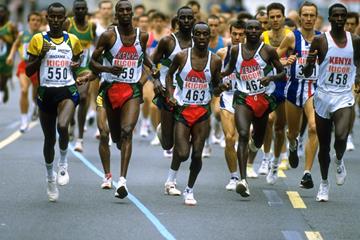 |
Moses Tanui(462) in the 1995 IAAF Half Marathon World Championships.
Photo courtesy of IAAF |
Tanui had recently(1993) demonstrated that the two minute barrier in the half marathon was possible. He'd run 59:47 in Milan and his feat would soon be accompanied by a host of other runners going faster. "What about breaking the two hour barrier in the marathon," I asked Moses. Yes, he believed he could do it.
The world record for the marathon in 1998 was 2:06:50, would later in the year drop to 2:06:05, a seemingly long way from 1:59:59. "Why do you believe you can run under two hours," I asked. "Because I have run a 1:59 half marathon and I felt like I could keep up that pace for another half," he said. Tanui never approached that time, but he was involved in setting the world record in the marathon a year later.
In 1999 Tanui raced Khalid Khannouchi in the Chicago Marathon. Around 30-35K into the race Tanui was feeling good. He thought the race was his. He bolted from the lead pack and opened up a lead over the rest. Khannouchi didn't panic. He gradually closed the gap and caught up with Tanui as the pair ran into the tunnel underneath McCormick Place. Khannouchi was the first to emerge and he didn't look back. He became the first to break 2:06 in the marathon running his first World Record for the distance of 2:05:42.
Khannouchi said after that race that physiological tests done on him indicated that he could run the marathon a lot faster. The scientists predicted he could run 2:03 for the distance. But Khannouchi was more conservative, pragmatic, and he copied the strategy of racing rather than record seeking runs. The reason being that the risk was too high if the scientists were wrong. If he had a bad day.
The marathon was not an event you could do the next week. It requires a recovery period before building up to run another marathon if you wanted to be at your best. One should only run two marathons a year was another belief held by many. More importantly winning the race and getting time bonuses that an event, such as Chicago, was offering was better approach than going all out to run to your limits if you wanted to be fiscally responsible.
Khannouchi took the approach of track athletes, such as high jumper Dwight Stones and pole vaulter Sergey Bubka of breaking their World Records by a small margin and not make another attempt to go higher that day once they had set a new record. Multiple pay days for record setting was much more lucrative than jumping as high as you could and setting a record that became out of reach for you as well as the your competition. In April of 2002, Khanouchi lowered his record in the marathon by four seconds in a race with the then World Cross Country Champion, Paul Tergat, and the Olympic 10K champion Haile Gebrselassie demonstrating, perhaps, that if you put the best distance runners in a particular discipline(Cross country, track, and marathon) that the specialist will prevail,
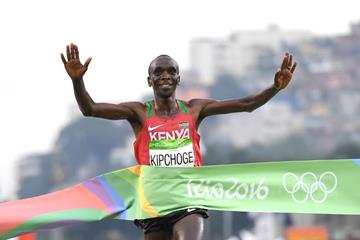 |
Eluid Kipchoge winning the 2016 Olympic Marathon.
Photo courtesy of the IAAF |
There was also doubt about how to run a marathon to get your best time. Should you go out fast? Run even pace? Try and negative split after a fast first half? Eluid Kipchoge had the benefit of nearly two decades of further study on these questions. The trio that was attempting to go under two hours were being paced to run even splits. Could Kipchoge have broken two hours by running slightly faster for the first half? What we do know is that Kipchoge proved yesterday that the two hour barrier is not impossible. The big question being how long and under what conditions will it take for somebody to do it?
Do you have to have the physiology and mental toughness possessed by Kipchoge to realistically attempt it? Will we now see more major marathons where the lead pack goes out in under an hour for the first half of the race? It will take more than a belief that it can be done. Tanui believed he could do it back in 1998, but the other marathoners did not. They weren't willing to take the risk of going out at a pace that, while now common in half marathon races, is not yet a comfortable pace for all but a small group of marathoners.
How much did the controlled environment contribute to Kipchoge's time? how much did the pacing help? The flat course? The "refueling," fluid replacement? Three men accepted the challenge. Only one came close. Is that significant or merely that the others "shut down" when it was clear they weren't going to get close to 1:59:59? Did the preparation done for the event only work for Kipchoge? Hopefully data was being collected that might provide hints to these questions. The myriad of variables invite conjecture, but defy the production of definitive answers yet.
By Jim Ferstle


 2
2


