
USATF Minnesota Indoor Meet #3 results are HERE.
Video interview with UMD's Sam Rivard and Grandma's Bob Gustafson on their Saturday Morning at the Races program for kids to be held at UMD this Saturday HERE.
New Yorker article and several photos from an exhibit on Masters Athletes titled Racing Age HERE.
Sunday, January 04, 2015

Saturday, January 03, 2015
Looking Back on 2014-The Multitaskers
If there is any real "down time" on the year-round track, road/trail/ultra, cross country seasons it's the XMas New Year's period. It's a logical time for reflection, memories from the past year. There were many. It was a good year for people in the sport with Minnesota ties.
I'm obviously not going to try and list everyone deserving of a mention, but rather focus a bit on a theme of "multitasking." Athletes/individuals who weren't only notable for their performances, but also for other contributions they made to the sport. For example, It was a banner year for Will Leer, who spends most of his time training and competing, but that's not all he does.
On the track Leer won the Wanamaker Mile at the Millrose Games indoors, etching his name on one of the signature events of every indoor season. He competed in the World Championships indoors, but was perhaps more importantly a leader more for what he said than what he did at the US Championships.
When Gabe Grunewald and Andrew Bumblough were disqualified in the women's and men's 3Ks, he didn't avoid the controversy. He used his post race interview after making the US team in his event to voice the opinion of the majority that the DQs were not fair nor proper. And he didn't stop there. Grunewald was reinstated, but it wasn't until the USATF Convention in December that Bumbalough was reinstated and the rules changed to hopefully avoid another situation like that being repeated.
Leer is a member of the Athletes Advisory Committee, and he has made the effort for the last four years to attend the convention and be active in the process of defending athletes rights, and advocating changes as needed to encourage fair and transparent treatment for athletes when disputes occur. His actions were not without risk, as sponsors and sports administrators tend to favor athletes who are seen but not heard. Athletes who avoid conflict rather than take a stand.
At the Honolulu Marathon to help pace Michigan coach and Canadian Olympian Kevin Sullivan in his first marathon, Leer and another Olympian, Nick Willis, rescued a damsel in distress, a woman who had fallen into the water after breaking her arm.
Another multi-tasker is the Queen of the Road Mile, Heather Kampf. Not only did Kampf make the US team for World Indoors and continue her success in road miles, she coaches cross country and track at Apple Valley HS. She has a "day job" at Mill City Running and does motivational speaking.
This multi-tasking is not a new thing for Kampf. As her mother will tell you, Heather was a whirlwind in High School at Rosemount, where in addition to being a State Champion in track, she did music and gymnastics, among other things. Kampf is seemingly always buzy with something. Not unlike one of her training partners, Masters runner Lance Elliott.
In addition to his own accomplishments as a Masters middle distance runner, Elliott is there for others, training with Kampf when she needs a partner, or with the Edina High School boys team when they needed to prepare for the NXN cross country championships.
All that and a full life attempting to keep up with the schedules of his own kids. At NXN, he not only helped the Edina team, he took photos of the races, documenting the races. During the NXN post race meal, he got a call from a reporter wanting to get some insight into how the races went in Portland. Aside from his pride in the fact that the Minnesota teams performed well--they did the State and Region Six proud, Elliott noted before passing the phone off to the Minnesota high school kids from Hopkins, Wayzata, Woodbury, and Edina, who were all gathered at the dinner table. It was their day.
 All these Minnesotans and more that made 2014 another outstanding year for the State's athletes. Double national champ Amanda Smock, who, like one of her mentors, Shani Marks Johnson, paid back Macalester College for the use of their facilities to train by coaching their triple jumpers. Dennis Barker, who stepped back a bit from multitasking as the coach at Augsburg and Team USA Minnesota to concentrate on Team USA Minnesota, coaching the high school team at Nova Academy, etc.
Carrie Tollefson: Olympian, mother, runner, broadcaster....All reaching new heights. All giving something back to the sport they love.
I'm obviously not going to try and list everyone deserving of a mention, but rather focus a bit on a theme of "multitasking." Athletes/individuals who weren't only notable for their performances, but also for other contributions they made to the sport. For example, It was a banner year for Will Leer, who spends most of his time training and competing, but that's not all he does.
 |
| Fear the Beard. Leer at Millrose. |
When Gabe Grunewald and Andrew Bumblough were disqualified in the women's and men's 3Ks, he didn't avoid the controversy. He used his post race interview after making the US team in his event to voice the opinion of the majority that the DQs were not fair nor proper. And he didn't stop there. Grunewald was reinstated, but it wasn't until the USATF Convention in December that Bumbalough was reinstated and the rules changed to hopefully avoid another situation like that being repeated.
Leer is a member of the Athletes Advisory Committee, and he has made the effort for the last four years to attend the convention and be active in the process of defending athletes rights, and advocating changes as needed to encourage fair and transparent treatment for athletes when disputes occur. His actions were not without risk, as sponsors and sports administrators tend to favor athletes who are seen but not heard. Athletes who avoid conflict rather than take a stand.
At the Honolulu Marathon to help pace Michigan coach and Canadian Olympian Kevin Sullivan in his first marathon, Leer and another Olympian, Nick Willis, rescued a damsel in distress, a woman who had fallen into the water after breaking her arm.
Another multi-tasker is the Queen of the Road Mile, Heather Kampf. Not only did Kampf make the US team for World Indoors and continue her success in road miles, she coaches cross country and track at Apple Valley HS. She has a "day job" at Mill City Running and does motivational speaking.
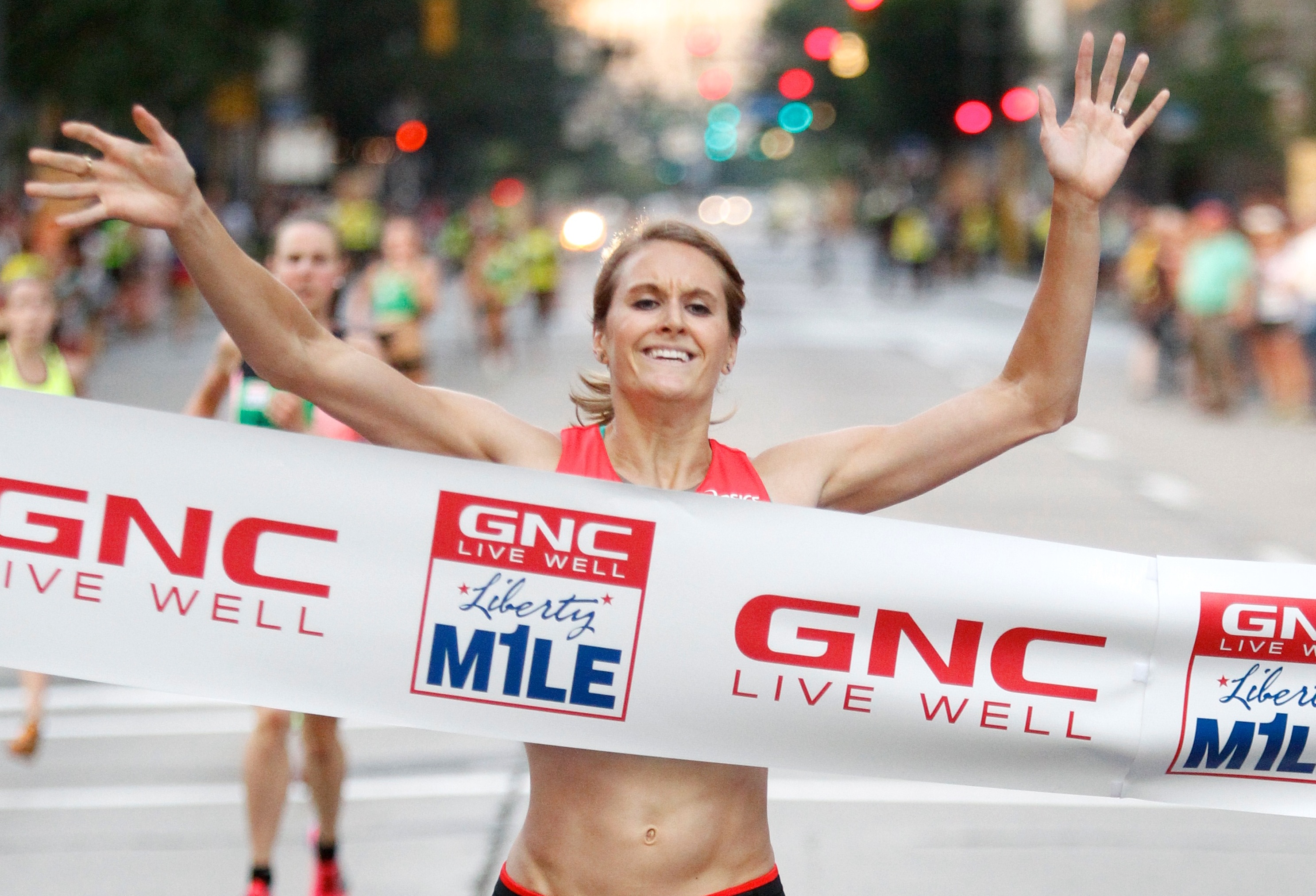 |
| The Quuen on her throne. |
 |
| Lance Elliott on the roads |
All that and a full life attempting to keep up with the schedules of his own kids. At NXN, he not only helped the Edina team, he took photos of the races, documenting the races. During the NXN post race meal, he got a call from a reporter wanting to get some insight into how the races went in Portland. Aside from his pride in the fact that the Minnesota teams performed well--they did the State and Region Six proud, Elliott noted before passing the phone off to the Minnesota high school kids from Hopkins, Wayzata, Woodbury, and Edina, who were all gathered at the dinner table. It was their day.
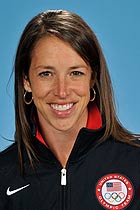 |
| Amanda Smock, Olympian |

 |
| Carrie Tollefson at the NYCM |
Friday, January 02, 2015
News: Bill Miles/Wayzata; Heather Kampf; Amanda Smock; Aris/F-M; Sleep
Sun Sailor story on retired Wayzata coach Bill Miles is HERE.
Another story, via @MNSunSailor, on retirement of @WayzataTrack legendary coach Bill Miles. http://t.co/PcHMgTl03I pic.twitter.com/7jTdXusr61
— Brian Maas (@TriGeekAddict) January 3, 2015
No. of @WayzataTrojans athletes receive 2014 Top 25 Sports Achievers honor from @MNSunSailor. http://t.co/mCl3J0vAkc pic.twitter.com/rQnllsKVDH
— Brian Maas (@TriGeekAddict) January 3, 2015
#Elites2015Indoor @TeamUSAMN's @HeatherRaeKampf wil be at @JDLFastTrack 1/31 & @MillroseGames 2/14. Will you be there @007TrackFan?
— Dennis Barker (@dbinsaintpaul) January 3, 2015
#1 USA Rankings per @tandfn for @AmandaBingson @AJTSMOCK @ShotDiva @hoffathrows @runmeb #teamnyac
— NYAC Track and Field (@NYACTrack_Field) January 3, 2015
DyeStat article on Fayetteville-Manlius coach Bill Aris HERE.Reseach on the potetntial impact of lack of sleep for young athletes HERE.
Thursday, January 01, 2015
News: Spotakova; Indoor Track Records; New Year's Resolutions; Road Race Drug Testing
Barbora Spotakova ranked number one in the world for women's javelin by Track and Field News HERE.
USATF Minnesota All-Time Indoor Track Records HERE
Some New Year's Resolutions from Ross Tucker of The Science of Sport website HERE.
Road races in UK, aside of the "IAAF Label" events rarely have drug testing HERE.
Wednesday, December 31, 2014
News: Heath on RT ROY list; Gabe Grunewald; MSHSL Outdoor Track Champs Qualifying Standards; Big Dreams
Garrett Heath only Minnesotan on Running Times 2014 Runners of the Year list HERE.
Athletics Illustrated interview with Gabe Grunewald from 2014 HERE.
Qualifying standards for MSHSL State Outdoor Championships HERE.
Athletics Illustrated interview with Gabe Grunewald from 2014 HERE.
Qualifying standards for MSHSL State Outdoor Championships HERE.
Back when @lawrence_char and I were just some little kids with big dreams #tbt http://t.co/qsurPPmqOd
— Nick Golebiowski (@nickgski) January 2, 2015
Tuesday, December 30, 2014
Rankings: T & F News Rankings: Barbora Špotáková; RT Top Marathon Races and Individuals
Gopher grad ranked seventh in the world by Track & Field News HERE.
Running Times list of top marathoners and Most Competitive Marathons(World and US) HERE Medtronic Twin Cities Marathon and Grandma's both ranked among top seven in the US. Annie Bersagel(2013) and other recent TCM champions Esther Erb(2014), Nick Arciniaga(2013), Fernando Cabada(2008), and Tyler Pennel(2014) among the top ten US marathoners.
Monday, December 29, 2014
Rankings: Top 50 US Track Athletes by State; Feel Good Stories; Ultrarunners of the Year; Elite Support
The Daily Relay names it's top US track athlete by State: Guess who was selected for Minnesota HERE.
The MSHSL trio of ninth grader Jessica Christoffer from Jackson County Central High, who fell from exhaustion 50 meters short of the finish line. Tierney Winter, a junior from Janesville, and Kailee Kiminski, a senior from Esko, who helped her, made the list of the five most feel good sports stories of 2014 in MinnPost.
Kaci Leckteig of Nebraska, winner and new women's course record holder at Ice Age Trail 50, named Ultrarunning Magazine's women's ultrarunner of the year HERE.
Why Oiselle supports elite runners HERE.
 |
| If there was a list of events to be dropped from the Olympics and the triple jump was on it, then.... |
The MSHSL trio of ninth grader Jessica Christoffer from Jackson County Central High, who fell from exhaustion 50 meters short of the finish line. Tierney Winter, a junior from Janesville, and Kailee Kiminski, a senior from Esko, who helped her, made the list of the five most feel good sports stories of 2014 in MinnPost.
Kaci Leckteig of Nebraska, winner and new women's course record holder at Ice Age Trail 50, named Ultrarunning Magazine's women's ultrarunner of the year HERE.
Why Oiselle supports elite runners HERE.
Sunday, December 28, 2014
Commentary: To New Heights
One of the featured stories during 2014 was the rumors surrounding the IOC's intent to manage the size of the Summer Olympics. One "suggestion" that caught people's attention was the rumor that events, such as the 200 meters, triple jump, and 10K would be dropped from the Olympic program.
The mere suggestion that such "surgery" would impact the track and field competition at the Games drew much response and a declaration that the suggestion was more fiction than fact. What is not disputed is that new IOC president Thomas Bach is serious about "modernizing" the Games, making it more attractive to certain audiences, and bolstering the "brand" of the Games against any attempts to cut into its commercial appeal.
This is not a new concept. Not that long ago wrestling and other sports were told they were in a pool of sports being considered from losing their spot in the Games. Wrestling took a proactive approach and mounted a successful campaign to convince the IOC of the viability of the sport on the Olympic program. Some have suggested that sports or events that are threatened should do the same.
As Peter Gambaccini wrote recently in Running Times, the track 10K is nearing extinction in the major European meets. The event has been deemed too long for video/TV broadcast and lacked, until the UK's Mo Farah swept the 5K and 10K titles at the IAAF and World Championships, a marketable champion for US and European audiences.
Even in road racing, the 5K and 10K events have taken a back stage to the marathon, half marathon, and road miles that have dominated the exposure for elite and non-elite events. If there is one event in track and field, however, that has thrived in the modern sports scene it's the pole vault. This year Sergey Bubka's World Record was finally broken indoors. All over the US and overseas, street vaults, beach vaults, and here in Minneapolis the Brits Pub Vault drew competitors and crowds.
The pole vault community has a large presence on social media with people, such as photographer Mike McCarthy posting daily photos on Twitter and currently counting down his top 20 PV photos of 2014.
For whatever reason the pole vault community has taken it upon itself to market the event and create a brand of their own. On January 16-17 in Reno, Nevada the 2015 UCS/Spirit Pole Vault Summit will be held again. Not only will top US vaulters past and present be there, but the new world record holder Renaud Lavillenie will be back again this year. There are sessions for high school vaulters on up to the Masters. The slogan for the event is: Encourage - Engage - Educate - Inspire
The events on the potential Olympic chopping block might want to follow the pole vault community's example. Show the world your event. Educate, engage, and inspire them. Show them why your event or events have value to the world of sports and the Olympic Games. USATF rejoiced at the increase in sponsor money in this year's budget. They might want to spread some of that around into event promotion. Even if the suggestion that events be dropped is only a rumor, increasing the visibility of these events can only help the sport as a whole.
As the saying goes: "God helps those who help themselves." Now would appear to be the time to follow that suggestion.
The mere suggestion that such "surgery" would impact the track and field competition at the Games drew much response and a declaration that the suggestion was more fiction than fact. What is not disputed is that new IOC president Thomas Bach is serious about "modernizing" the Games, making it more attractive to certain audiences, and bolstering the "brand" of the Games against any attempts to cut into its commercial appeal.
This is not a new concept. Not that long ago wrestling and other sports were told they were in a pool of sports being considered from losing their spot in the Games. Wrestling took a proactive approach and mounted a successful campaign to convince the IOC of the viability of the sport on the Olympic program. Some have suggested that sports or events that are threatened should do the same.
As Peter Gambaccini wrote recently in Running Times, the track 10K is nearing extinction in the major European meets. The event has been deemed too long for video/TV broadcast and lacked, until the UK's Mo Farah swept the 5K and 10K titles at the IAAF and World Championships, a marketable champion for US and European audiences.
Even in road racing, the 5K and 10K events have taken a back stage to the marathon, half marathon, and road miles that have dominated the exposure for elite and non-elite events. If there is one event in track and field, however, that has thrived in the modern sports scene it's the pole vault. This year Sergey Bubka's World Record was finally broken indoors. All over the US and overseas, street vaults, beach vaults, and here in Minneapolis the Brits Pub Vault drew competitors and crowds.
The pole vault community has a large presence on social media with people, such as photographer Mike McCarthy posting daily photos on Twitter and currently counting down his top 20 PV photos of 2014.
Pole Vault Photo of the Year - TOP 20
#20 @airlavillenie from Oct 7
#polevault http://t.co/DmEMo2fYXS
@Nike pic.twitter.com/7FKoulBekB
— Mike McCarthy (@McCarthysan) December 28, 2014
For whatever reason the pole vault community has taken it upon itself to market the event and create a brand of their own. On January 16-17 in Reno, Nevada the 2015 UCS/Spirit Pole Vault Summit will be held again. Not only will top US vaulters past and present be there, but the new world record holder Renaud Lavillenie will be back again this year. There are sessions for high school vaulters on up to the Masters. The slogan for the event is: Encourage - Engage - Educate - Inspire
The events on the potential Olympic chopping block might want to follow the pole vault community's example. Show the world your event. Educate, engage, and inspire them. Show them why your event or events have value to the world of sports and the Olympic Games. USATF rejoiced at the increase in sponsor money in this year's budget. They might want to spread some of that around into event promotion. Even if the suggestion that events be dropped is only a rumor, increasing the visibility of these events can only help the sport as a whole.
As the saying goes: "God helps those who help themselves." Now would appear to be the time to follow that suggestion.
Saturday, December 27, 2014
News: Memorable Moments of 2014; Undaunted; LR 1500 Rankings: Farmington
FloTrack has a list of memorable events and people from 2014 that features several Minnesotans. In Moments of the Year, flormer Twin Cities resident Elizabeth Herndon and the Beer Mile are featured HERE. Gopher distance runner Kate Bucknam and her role in the sportsmanship moment is HERE. Gabe Gruewald's IAAF Indoor Championship race moment is HERE.
The FLOPRO Series of the year featured Kara Goucher HERE.
Undaunted: Chasing History at the Boston Marathon, story of a new documentary on one person's quest HERE.
Will Leer was ranked fifth in the Let's Run men's US rankings HERE. Garrett Heath got Honorable Mention. Gabe Grunewald and Heather Kampf were Honorable Mentions in Let's Run's women's 1500 rankings HERE
The FLOPRO Series of the year featured Kara Goucher HERE.
Undaunted: Chasing History at the Boston Marathon, story of a new documentary on one person's quest HERE.
Will Leer was ranked fifth in the Let's Run men's US rankings HERE. Garrett Heath got Honorable Mention. Gabe Grunewald and Heather Kampf were Honorable Mentions in Let's Run's women's 1500 rankings HERE
Neither rain, nor sleet, nor snow...
There. A usable track again. #runnerspace #tracknation #trackandfield #400m http://t.co/uRILl78Kbw pic.twitter.com/nlnxovyvdN
— Scott Meier (@ScottMeier1) December 28, 2014
Friday, December 26, 2014
News: Masters Runner Bewildered by USADA Doping Ban; Will Leer/Aisha Praught Lake Calhoun Run
Colorado Masters trail runner "bewildered" by USADA ban HERE
Despite being the white day after the day after XMas, starting at 10AM Saturday morning Will Leer will be leading a run from Thomas Beach on Lake Calhoun. He won't be running barefoot or in shorts and a singlet. Oregon Track Club Elite's Aisha Praught will be there too.
Despite being the white day after the day after XMas, starting at 10AM Saturday morning Will Leer will be leading a run from Thomas Beach on Lake Calhoun. He won't be running barefoot or in shorts and a singlet. Oregon Track Club Elite's Aisha Praught will be there too.
 |
| Will Leer after setting a PR in the Mile in Ireland this summer. |
Wednesday, December 24, 2014
Tuesday, December 23, 2014
News: LA Prepping for Marathon Trials; Preventing Injuries Through Science; Lornah Kiplagat
The LA Marathon staff are preparing for the 2016 US Olympic Marathon Trials HERE.
Sports Illustrated story on attempts to prevent injuries using sports science HERE.
Some of you might remember Lornah Kiplagat, a top Kenyan distance runner, who this year launched a women's sportswear line. The online catalog is HERE.
Sports Illustrated story on attempts to prevent injuries using sports science HERE.
Some of you might remember Lornah Kiplagat, a top Kenyan distance runner, who this year launched a women's sportswear line. The online catalog is HERE.
Monday, December 22, 2014
UMD Women Race to the Podium
 |
| (Left to Right) Lauren Bruha, Kara Thul, Emily Muellner, Ellie Stepaniak, Emi Trost, Kaelyn Williams, Natalie Stauber, McKenzie Holt, Natalie Kessler, Brittany Platt, Amber Seidenkranz, Erica Seidenkranz, Breanna Colbenson, Sam Rivard, Caitlin Richard, Allie Rudin, Hannah Olson, Kat Ocariz and (below)Head Coach Joanna Warmington. Missing: Hannah Jocelyn. Photo Courtesy of UMD |
While the XC team was piling up points at the DII Nationals, indoor season was just starting back in Minnesota. In the time following their XC triumph, the team did have a post race roll in the mud. They were happy that they'd placed third, but they also knew that second place was not that far away. All but one of this year's team, the team's final scorer Alex Rudin, will graduate.
So, Warmington spent much of the post meet, pre Christmas vacation time having one-on-one sit downs with "about 60 athletes," giving them training schedules for the time away from school. indoor season was underway and XC was in the review mirror, but what a lovely sight it was.
This year's NCAA DII XC schedule had two week breaks between both Conference and Regionals. The challenge was getting and keeping them sharp for the last month of the season. It didn't help that about a week of five degree weather and ice, not that unusual in Duluth, had everyone retreating indoors with workouts to help turnover and speed, but being careful not get injured. "It was a long season," said Warmington, so the key objective over the last month of the season was to keep everyone healthy.
Being on the podium was this year's goal. Next year Grand Valley State graduates all but two of their team members, but those two finished first and second overall and a lot can happen in a year. "We'll miss Alex," said Warmington. Rudin provided leadership from the pack on a team with a lot of talent. Sam Rivard led the team all year, but had a hard time in the mud at Nationals, Warmington said.
The rest of the team were better "mudders." Freshman Emi Trost, sophomore Breanna Colbenson, junior Hannah Olson, and Rudin had the strength to handle the challenging footing, while Rivard is more speed oriented as evidenced last year when she won the 1600 and was third in the 3,000 at DII Indoor Nationals. In outdoor track, she doubled again placing second in the 5,000 and seventh in the 10K.
Trost, said Warmington, is convinced she is not as suited for the longer distances, but placed only four seconds and four places behind Rivard at NCAA's. "She doesn't like the long stuff," said Warmington, but Warmington wonders if Trost might be better at a longer distance and while Trost will run primarily 800 and 1500, Warrington wants her to try the 3,000 as well.
Trost won the MSHSL 800 in 2013 for her first State title, then followed that up with a cross country win. In her last track season for Cannon Falls, Trost suffered her first major injury and had limited training during her senior year in track but still won the 3200 title. All she's lacking at this point is confidence, said Warmington.
At DII XC Nationals Colbenson, Olson, and Rudin provided the key points in the key positions to allow UMD to rise from a tenth place finish a year ago to the podium.
Because they were such a young team Warmington had them race a lot, often training through events. They captured their first major goal during a hard training week when they won the Griak in the Women's Maroon DII race in September. The racing, Warmington believes, is the best way to learn how to race. "I learned a lot from the girls," said Warmington of the the info she gathered as they raced their way through the season.
 |
| The UMD lead pack at Oshkosh. Colbenson(802), Rivard(810), and Trost(81). Photo courtesy of UMD |
The team never finished below third. They "came together as a team" at Oshkosh, said Warmington. The Wisconsin competition was their second meeting in two weeks against Grand Valley State and UMD closed the gap on the number one ranked team in DII, placing second. Prior to that at the Notre Dame Invitational the Bulldogs tested themselves against DI, DII, and DII teams and finished third behind Grand Valley State and DI Duquesne. The only real sub par meet of the season was the NSIC Conference Championship where they tied for first on points with Augustana, but came in second in the tiebreaker.
If your only down meet was a tie for first, that gives a pretty good indicator of how successful 2014 was for UMD's cross country women.
News: US Team for BUPA Great Edinburgh XC;Competitor Top Runners of 2014; Hot Spot
Roster for US team at the BUPA Great Edinburgh XC is HERE. Two Minnesotans on Senior team: Emma Bates and Jon Grey. 2014 Medtronic TCM men's winner Tyler Pennel also running.
Competitor Magazine top runners of the year HERE. Includes Metronic TCM Masters champ, Mbarak Hussein and Laura Roesler
Competitor Magazine top runners of the year HERE. Includes Metronic TCM Masters champ, Mbarak Hussein and Laura Roesler
The new @surlybrewing brewery is the MPLS hot spot. Besides a gopher runner reunion, I saw @MNXCCoachHop, @TheJennaRader, and @MayorRTRybak
— Jamie Cheever (@JamieCheever) December 23, 2014
Sunday, December 21, 2014
News: Underreported Stories; Stress Fractures; Kenyans; Ron Hill; Fatigue
Stories on Alysia Montano and Tatyana McFaddin, one pregnant, the other continuing her dominance. Both under reported during 2014 HERE.
Journal paper on stress fractures, what causes them, how to heal from them, manage them HERE.
Physiology isn't the only reason for success by Kenyan runners HERE.
What have you done every day for the last 50 years? The UK's Ron Hill has run at least one mile HERE. Hill finished fifth in the 1975 Boston Marathon. Can you name the Minnesotan who finished three places in front of him?
It was the Green Bay Packers coach Vince Lombardi who is credited with the quote: "Fatigue makes cowards of us all." Scientific studies has shown that a bit of motivation can counteract that fatigue HERE. the power of positive thinking.
Saturday, December 20, 2014
News: USATF MN Indoor Meet #2 Results; End of Season HS Individual Rankings; From the Choir to Cross Country; Tyler Pennel Interview
Results from the USATF Minnesota Indoor Meet #2 at Bethel are HERE
Dyestat final individual boys' rankings HERE, girls HERE.
MIAC student-athlete spotlight on St. Ben's Jenna O'Donnell is HERE. From the choir to cross country: "When coming to the College of Saint Benedict I had no intention of being an athlete. My plan was to focus solely on my academics and to join the choir."
Belated listing of first UMAC Indoor track athletes of the week from December 9 HERE.
Interview with 2014 Medtronic Twin Cities Marathon men's champion Tyler Pennel HERE.
Dyestat final individual boys' rankings HERE, girls HERE.
MIAC student-athlete spotlight on St. Ben's Jenna O'Donnell is HERE. From the choir to cross country: "When coming to the College of Saint Benedict I had no intention of being an athlete. My plan was to focus solely on my academics and to join the choir."
Belated listing of first UMAC Indoor track athletes of the week from December 9 HERE.
Interview with 2014 Medtronic Twin Cities Marathon men's champion Tyler Pennel HERE.
I start and finished my long run with @HassyHass35 for two weeks in a row now! So does that mean I can run 13:01? Or #ImJustdreaming
— Harun Abda (@Ha_RunAbda) December 22, 2014
Friday, December 19, 2014
Aaron Bartnik: Running to the Beat of a Metronome
 |
| THEN: Aaron Bartnik winning the 1999 MSHSL AAXC Championship. Photo by Dennis Hahn |
A healthy Aaron Bartnik led the Gopher men's cross country team from start to finish this year. During his interview Bartnik talks about dealing with potential career threatening injuries. Using a metronome app to help him stay healthy, his last HS XC race, what he learned from this year's experiences, and his goals for the future.
Down the Backstretch:
Your junior year seems to be a good year for you. You won the MSHSL XC
championship as a junior at Eden Prairie. This year you had a breakout season
leading the Gophers. Aside from being injury free what helped you be successful
this cross country season?
Aaron
Bartnik: Being patient has been important. I had to accept that I wasn’t going
to see exceptional results immediately after my first injury-free season. In
addition to this, I have prioritized a healthy lifestyle. I am never going to
get the most out of myself as an athlete if I am not eating well, getting enough
sleep, and staying healthy.
DtB: How did you cope
with the frustration of being seemingly cursed with stress fractures? Why did
you keep coming back from the injuries? I’ve been told that there were points
where you considered quitting.
AB: It was a
couple difficult years of continuous injuries. I tried as hard as I could to
stay positive, but it got difficult at times. After spending an hour or more
cross training every day for a couple years in a row, I started to question
things. So yes, I most certainly considered quitting. I came to the University
of Minnesota to run, not to aqua jog.
While I had
fantastic high school cross country experiences, I often wondered how good I
could be at the next level. I didn’t know how I would develop with the increase
in training that comes with collegiate sports, and I wanted to test the limits
of my body. Could I be one of the best on my team? One of the best in the Big
Ten? One of the best in the nation?
NCAA athletics is a once in a lifetime
opportunity, and I knew I would never be able to answer those questions if I
moved on and gave up on my collegiate running career. My main motivation for
persevering came from this internal desire to be the best athlete I could be. In
addition to this, I wanted to give back to the University that gave so much to
me. Being a Division I athlete is a huge privilege, and I wanted to represent
the school that has made my college experiences so great.
DtB: The solution for
you has been working to change your stride. Changing one’s “mechanics” has been
in the news a lot of late within the distance running community, not to lessen
the chance for injury but on the premise that if you can become more efficient,
you’ll use less energy and be able to run faster. How does one go about
changing one’s stride? Is it something that is easy to change or did it take
some time to feel comfortable with your “new stride?”
AB: It was a
difficult task and I had to be patient with it; I am thankful for being
introduced to physical therapist Blake Butler at TRIA
Orthopaedic. Blake was able to identify numerous inefficiencies in my stride,
including but not limited to a low turnover rate and a lack of activating my
glutes.
My stride
rate was at about 160 foot strikes per minute, and as a result of this slow
turnover rate, I had a lot of vertical movement. We suspected this was the
primary stressor of my bone related injuries. My goal was to get my stride rate
up to 180.
I installed a metronome app on my phone, set it to a tempo that was
uncomfortably quick but reasonably achievable, and I matched my foot steps to
the beat. Over about two months I worked my way up to 180 beats per minute.
It
was a mentally exhausting exercise. I had so much to focus on with the movement
of my own body, that the repetition of the metronome didn’t bother me too much.
In addition to the issue of turnover, I performed a set of muscle memory
exercises every day that taught me to activate my glutes when my heels hit the
ground.
DtB: Do you have to
consciously think about it? Do you find yourself reverting back to your “old
stride” at all? When you get tired?
AB: It comes
pretty naturally now, but it is definitely still a work in progress. I have a
little mental checklist that I go through every run to make sure I am doing all
the little things right. And still
today, over a year after changing my stride, I will still occasionally use the
metronome and focus entirely on form for a run.
DtB: If somebody who had
watched you last year and then looked again this year would the change in your
“mechanics” be noticeable or are they more subtle than that?
AB: I think
it would be very noticeable if they saw me on an everyday run, but maybe not as
much in races. Turnover naturally increases with pace, so I always had decent
turnover in races. Considering that races only count for a small percentage of
my total running, it is what I am doing in practice that is more important when
it comes to injury prevention.
DtB: Do you have any
advice for other runners dealing with stress fractures?
AB: When
dealing with the mental side of injuries, setting goals is important. It was
helpful for me to remind myself of my goals every day. On a personal level, you
have to know what things you are willing to making sacrifices for. If you are
passionate enough about your goal, you will be able to persevere through any
injury.
On the
physical side of things, I think it is important to find the root cause of the
problem. Stress fractures commonly stem from poor running form, a muscular
imbalance, or dietary issues. If you don’t have a plan to overcome the injury,
consult help. While the stress fracture will heal with time, there is a good
chance it will happen again unless you find the underlying problem.
DtB: Both your high
school and college coaches have noted that you were often able to produce top
performances on very limited training. Bruce Mortenson says he thought your
third place finish in the MSHSL XC Championships was more impressive than when
you won State your junior year. I would guess that being able to do that would
elicit both hope and frustration. Sort of “What could I do if I was ever
healthy?”
AB: I
actually consider myself someone who needs a big base of aerobic training to run
well. I firmly believe in the importance of training with consistency. It wasn’t
until almost a year of staying injury-free when I started to really feel like
myself racing again.
The state meet my senior year was an exception. To this
day, I am extremely proud of myself for that race. The metatarsal stress
fracture I developed about a month before the state meet had limited my training
to at most a couple short runs a week. I was probably hurting more at 4K of that
race than I was at the finish line of any other race that season.
Plus, I lost
to two extremely talented athletes in Adam Zutz and Cole O’Brien. You can always
play the “What if I were healthy” game, but I understood that injuries are a
natural occurrence in running, and that I would get back to performing at a top
level with time.
DtB: The NCAA
Championships this year was another of those “double edged sword” experiences.
You made it to Nationals. You were within striking distance of making All
American, but the body wouldn’t respond. Was it just the illness the week prior
to the race? Is there a clear answer as to why you weren’t able to make the
move you wanted to in that race?
AB: I do
believe the illness was the primary cause of my sub-par performance. I was ready
to go mentally, but running a 10K against the top runners in the NCAA is no easy
task healthy, let alone sick.
DtB: It was your first
chance at the NCAA XC champs. What did you learn that might help you get back
there again next year and get the result you want?
AB: Seeing
all the top-caliber runners before, during, and after the race, my biggest
takeaway is that everyone is human. I think it is important to not limit
yourself when comparing your performance with others; not a single athlete in
the NCAA is unbeatable no matter what Flotrack says. Plus, my disappointment in
this year’s NCAA result will only motivate me to achieve more next year. The
plan is to qualify for nationals with the team next year, and for me to
significantly improve on my performance.
DtB: What are the goals
for the upcoming track season, aside from staying healthy?
AB: I
definitely want to break 14 minutes in the 5K this year, but more importantly,
my biggest goal is to be as competitive as possible within the Big
Ten.
DtB: Are you thinking of
running post collegiately or is it too early to make that kind of
decision?
AB: It is too
early to tell. I know very little about post-collegiate running, and I definitely didn’t go to college with plans of running competitively after
graduation. But, if I continue to develop as an athlete, and feel that I have
something to prove after my collegiate eligibility, then I will most certainly
consider it.
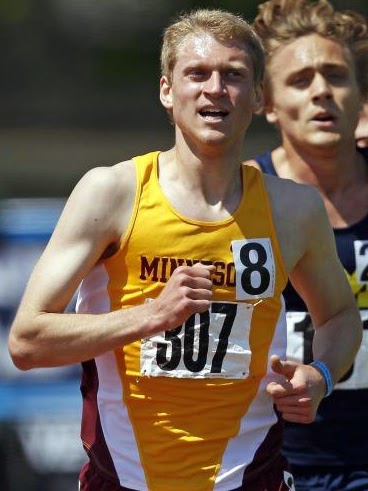 |
| Now: Bartnik racing on the track. Photo courtesy of U of MN |
News: Reflections on Bill Miles' Retirement; Jon Peterson; WR Stats; USATF
From Wayzata, some reflections on Bill Miles HERE.
Competitor Q&A with Team USA Minnesota's Jon Peterson is HERE.
For those of you who love statistics, there are comparisons between the men's and women's World Records HERE.
Lauren Fleshman on USATF HERE. Jon Gugala writes on USATF actions at the convention HERE
Competitor Q&A with Team USA Minnesota's Jon Peterson is HERE.
For those of you who love statistics, there are comparisons between the men's and women's World Records HERE.
Lauren Fleshman on USATF HERE. Jon Gugala writes on USATF actions at the convention HERE
Varied Comments on the Latest Doping Crises
Varied comments on the latest doping crises in the sport.
Getting busted for coke during a competition? Ya, that still happens, apparently. http://t.co/HupaGtgOLZ
— Chris Nickinson (@chrisnickinson) December 19, 2014
Kenya’s doping defense: We’re not as bad as Russia or China: http://t.co/EeVpUSaWMw
— Philip Hersh (@olyphil) December 19, 2014
8 years for Drummond, 1 year for Gay.. Makes you say hmmmmmmmm...
— Dwight Phillips (@Dwightdagreat) December 19, 2014
Belated congratulations to our new Boston, Chicago, and World Marathon Majors Champions. #cleansport http://t.co/izP2pWqeNk
— Picky Bars (@pickybars) December 19, 2014
I'll make sure we implement anti-doping campaigns to educate the new track stars & the veterans.
— Dwight Phillips (@Dwightdagreat) December 19, 2014
I would personally pitch in financially to a kickstarter to put anti-doping labs in hard to reach places like the Rift Valley.
— Lauren Fleshman (@laurenfleshman) December 19, 2014
Kenya’s doping defense: We’re not as bad as Russia or China: http://t.co/EeVpUSaWMw
— Philip Hersh (@olyphil) December 19, 2014
Elite sport's credibility on the line with doping issues: Arne Ljungqvist | Zee News http://t.co/1KsynGo0er
— Anti-Doping Database (@Dopinglist) December 19, 2014
Wednesday, December 17, 2014
News: 10 Best Mile Moments in 2014; Davina Carr; USATF Club Champs Men's Race Short? Bowerman Awards
Bring Back the Mile lists the 10 best mile moments in 2014 HERE. Plenty of Minnesotans on the list.
Outside magazine article on Sally Bergesen and her crusade to change the running industry HERE.
Bismark Tribune story on U-Mary pole vaulter Davina Carr is HERE.
Let's Run questioning the length of the 10K(?) men's USATF Club Championships HERE.
Congrats again to @deonlendore and @lroesler5 on winning the 2014 @thebowerman Trophy!
http://t.co/DZhvPFQGfT pic.twitter.com/k7FLtWehvn
— USTFCCCA (@USTFCCCA) December 18, 2014
Subscribe to:
Posts (Atom)