
Showing posts with label Dick Beardsley. Show all posts
Showing posts with label Dick Beardsley. Show all posts
Friday, May 19, 2017
Dick Beardsley Shows that Knee Replacement Surgery Doesn't have to End One's Ability to Run and Race
Outside magazine article on Dick Beardsley's Demonstration that Knee Replacement Surgery does not end one's ability to run and race.

Friday, August 12, 2016
Monday, May 23, 2016
Monday, April 18, 2016
Thursday, April 23, 2015
Dick Beardsley and Inge Simonson Retell the Story of The Tie
Dick Beardsley and Inge Simonsen tell the tale of their tie at the first London Marathon 35 years ago HERE.
Sunday, June 22, 2014
Grandma's Helps Fund Another Career
It's been a tough week for three decade old records. Last weekend a trio of high school kids from Long Island's Northport HS tied the 39 year old feat of three Hammond High School distance runners by running sub-nine minute two miles at the New Balance HS Nationals in North Carolina. Yesterday, Dick Beardsley's 33 year-old course record for Grandma's Marathon was beaten by Kenyan Dominic Ondoro, who finished the race in 2:09:06, 31 seconds better than Beardsley's 1981 mark.
Also yesterday at the Brooks PR Invitational in Seattle, the Northport trio that tied the Hammond High record almost set a new one in the 4 by 1 mile relay. The record was set in 1976 by a team from South Eugene, Oregon who ran 17:06.6. The Northport trio, plus one, ran 17:06.92. Since the 4 by 1-mile is seldom run, that record might survive into a fourth decade.
The theme for the other two record performances was that the holders of the old marks all wondered why their records lasted so long. Beardsley, who was doing his usual radio reporting at Grandma's again this year, was surprised at the longevity of his record. At the time he had his breakthrough run along the shores of Lake Superior the World Record for the marathon was in the low 2:08s(Rob De Castella's 2:08:18 was the official record at the time. Alberto Salazar had run 2:08:13 in the New York City Marathon, but his mark had been disallowed because of course measurement issues. The course had been measured along the blue line painted on the streets, not the shortest possible route the runners could take thus creating the possibility that the runners had not run the full 26.2 miles.)
While Kenyans had become the dominant nation in Olympic distance running by 1981, the marathon was the one event where they still lagged behind the Ethiopians. As more Kenyans began to move up to or begin their careers as marathoners, the odds increased that Beardsley's record would fall. With the current World Record for the distance being in the 2:03s and the number of marathons run between 2:03 and 2:09 increased exponentially it was only a matter of time before one of the second or third tier Africans came to Duluth and made a run for the record.
Ondoro, who has a PR for the distance of 2:08:00, which was set in Israel last year, does not get the invitations to major events, such as the World Marathon Major events in Chicago, New York, London, Boston, or Tokyo. This year, for example, Ondoro ran 2:11:43 in Houston to begin his 2014 campaign, and followed that up with a seventh at the Credit Union Cherry Blossom 10-mile in Washington, DC, and a tenth place finish at the Bloomsday 12K, before coming to Grandma's.
The weather, if not the erratic early pace, provided the field with conditions very similar to 1981 and Ondoro, along with other Africans in the field ran fast enough early enough to set up Ondoro's run for the record late in the race. Ondoro came through the half in 1:04:46, a pace that would have put him just under Beardsley's mark if he duplicated it in the second half, but near where the race really starts in a marathon, mile 20, Ondoro put it in another gear and ran the 21st mile in 4:39, about the average pace per mile of the current marathon World Record, and Beardsley, riding in the press truck in front of the race, knew his record was history.
The memories of that day in 1981 flashed back. It was an era in which US male marathoners were still prominent in the top ten lists of marathon performers. Frank Shorter had dominated Olympic marathon racing in the 1970s and Salazar looked to be the heir to his throne. Just as Gopher grad Leonard "Buddy" Edelen had led the development of US talent in the event back in the '60s by setting a then World Record of 2:14:28 in 1963, another Gopher, Steve Hoag, finished runner up in Boston in 1975 in 2:11:54. Ron Daws made the 1968 Olympic team and served as a mentor to Hoag and other Minnesota distance runners who wanted to move up in distance.
In 1980, still another U of M grad, Garry Bjorklund, who was an Olympian at 10K in 1976, had planned to transition to the marathon for the 1980 Olympics in Moscow. The US boycott scuttled those plans, but Bjorklund, furious at the US government for mandating the boycott, took out his anger at that year's Grandma's race, setting the then course record of 2:10:05, accompanied during the full distance by Bill Kennedy, who was the elite escort for the men riding a ten speed in front of the race.
Kennedy, then a Dayton's employee, contributed to the running boom in other ways. He was the founding race director of the Get in Gear 10K that now hosts runners going a variety of distances in the annual rite of Spring running in Minnesota. While Bjorklund was experimenting with the marathon as a possible way to be an Olympic medal contender, Beardsley, the Wayzata High School grad, continued his running career in junior college by running multiple distances in meets until he discovered where his running talent blossomed, the marathon. (Junior college was the only national collegiate meet to include a marathon among its championship events).
Beardsley steadily bettered his times in the event. He qualified and placed 16th at the US Olympic Marathon Trials in 1980, beginning a string of 13 marathons where he bettered his personal best in each. New Balance sponsored his fledgling running career at a time when Beardsley's first wife, Mary's, parents often asked her when her husband was going to get a "real job." In 1981 Beardsley got an invite to run the first London Marathon. He tied for first in 2:11:38. Two months later he came to Duluth aiming for another breakthrough.
Bjorklund, also sponsored by New Balance, wasn't racing fit. He had put on a few pounds, but volunteered to help Beardsley run fast. He wasn't really a pacer, but rather a mentor, a sensei for this young marathoning prodigy. The pair ran side by side until they turned off of old Hwy 61 and headed into Duluth. There the "student" was transformed into the master as he ran on to break 2:10 and set the course record that stood for the last three decades. To this day, Beardsley maintains that his accomplishment on June 20, 1981 was inferior to Bjorklund's, who ran 2:11:31 without adequate preparation.(A typewritten copy of the 1981 Grandma's results that include both men's and women's course records is HERE.)
The London win and the Grandma's time launched Beardsley's career. New Balance offered him more money, a $50,000 a year contract, and Mary's parents no longer asked about the "real job." For Ondoro, the record setting win will offer a similar financial boost. He won $10,000 for finishing first along with $5,000 for breaking the course record and a car donated by race sponsor Toyota worth $16,000.
The $31,000 payday will get funneled into the Kenyan economy. Ondoro told reporters after the race that the money will allow him to buy more cattle, maybe help fund a school. While the money Ondoro won is not much by professional US sports standards, it will go a long way in Kenya. This opportunity to fund a better life is the reason the US road running circuit is filled with young African runners seeking financial security. Just as 33 years ago when road racing helped launch the career of a US junior college Agriculture major named Beardsley.
 |
| Ondoro at the finish |
The theme for the other two record performances was that the holders of the old marks all wondered why their records lasted so long. Beardsley, who was doing his usual radio reporting at Grandma's again this year, was surprised at the longevity of his record. At the time he had his breakthrough run along the shores of Lake Superior the World Record for the marathon was in the low 2:08s(Rob De Castella's 2:08:18 was the official record at the time. Alberto Salazar had run 2:08:13 in the New York City Marathon, but his mark had been disallowed because of course measurement issues. The course had been measured along the blue line painted on the streets, not the shortest possible route the runners could take thus creating the possibility that the runners had not run the full 26.2 miles.)
While Kenyans had become the dominant nation in Olympic distance running by 1981, the marathon was the one event where they still lagged behind the Ethiopians. As more Kenyans began to move up to or begin their careers as marathoners, the odds increased that Beardsley's record would fall. With the current World Record for the distance being in the 2:03s and the number of marathons run between 2:03 and 2:09 increased exponentially it was only a matter of time before one of the second or third tier Africans came to Duluth and made a run for the record.
Ondoro, who has a PR for the distance of 2:08:00, which was set in Israel last year, does not get the invitations to major events, such as the World Marathon Major events in Chicago, New York, London, Boston, or Tokyo. This year, for example, Ondoro ran 2:11:43 in Houston to begin his 2014 campaign, and followed that up with a seventh at the Credit Union Cherry Blossom 10-mile in Washington, DC, and a tenth place finish at the Bloomsday 12K, before coming to Grandma's.
The weather, if not the erratic early pace, provided the field with conditions very similar to 1981 and Ondoro, along with other Africans in the field ran fast enough early enough to set up Ondoro's run for the record late in the race. Ondoro came through the half in 1:04:46, a pace that would have put him just under Beardsley's mark if he duplicated it in the second half, but near where the race really starts in a marathon, mile 20, Ondoro put it in another gear and ran the 21st mile in 4:39, about the average pace per mile of the current marathon World Record, and Beardsley, riding in the press truck in front of the race, knew his record was history.
.jpg) |
| Start of the 1975 Boston Marathon. Steve Hoag is number 6 third from the right near race winner Ron Hill(1) |
In 1980, still another U of M grad, Garry Bjorklund, who was an Olympian at 10K in 1976, had planned to transition to the marathon for the 1980 Olympics in Moscow. The US boycott scuttled those plans, but Bjorklund, furious at the US government for mandating the boycott, took out his anger at that year's Grandma's race, setting the then course record of 2:10:05, accompanied during the full distance by Bill Kennedy, who was the elite escort for the men riding a ten speed in front of the race.
Kennedy, then a Dayton's employee, contributed to the running boom in other ways. He was the founding race director of the Get in Gear 10K that now hosts runners going a variety of distances in the annual rite of Spring running in Minnesota. While Bjorklund was experimenting with the marathon as a possible way to be an Olympic medal contender, Beardsley, the Wayzata High School grad, continued his running career in junior college by running multiple distances in meets until he discovered where his running talent blossomed, the marathon. (Junior college was the only national collegiate meet to include a marathon among its championship events).
 |
| Beardsley(arm raised) and Norway's Inge Simonsen at the finish of the London Marathon |
 |
| 1981. The dual in the mist. Dick Beardsley and Garry Bjorklund(1) |
Bjorklund, also sponsored by New Balance, wasn't racing fit. He had put on a few pounds, but volunteered to help Beardsley run fast. He wasn't really a pacer, but rather a mentor, a sensei for this young marathoning prodigy. The pair ran side by side until they turned off of old Hwy 61 and headed into Duluth. There the "student" was transformed into the master as he ran on to break 2:10 and set the course record that stood for the last three decades. To this day, Beardsley maintains that his accomplishment on June 20, 1981 was inferior to Bjorklund's, who ran 2:11:31 without adequate preparation.(A typewritten copy of the 1981 Grandma's results that include both men's and women's course records is HERE.)
The London win and the Grandma's time launched Beardsley's career. New Balance offered him more money, a $50,000 a year contract, and Mary's parents no longer asked about the "real job." For Ondoro, the record setting win will offer a similar financial boost. He won $10,000 for finishing first along with $5,000 for breaking the course record and a car donated by race sponsor Toyota worth $16,000.
The $31,000 payday will get funneled into the Kenyan economy. Ondoro told reporters after the race that the money will allow him to buy more cattle, maybe help fund a school. While the money Ondoro won is not much by professional US sports standards, it will go a long way in Kenya. This opportunity to fund a better life is the reason the US road running circuit is filled with young African runners seeking financial security. Just as 33 years ago when road racing helped launch the career of a US junior college Agriculture major named Beardsley.
Saturday, June 21, 2014
History Made at Grandma's
Thirty three years ago two Minnesota marathoning legends Garry Bjorklund and Dick Beardsley, ran stride for stride for most of Grandma's Marathon on an overcast, misty day nearly perfect for performing. The race that day was a changing of the guard in US marathoning and confirmation of Beardsley's talent, who was then an emerging marathoner on the national and international scene. This year a marathoner from a nation full of distance running talent, Dominic Ondoro, ripped a 4:39 21st mile on his way to breaking Beardsley's course record and nearly breaking 2:09 to win the men's race in 2:09:06.
Clad in a long sleeved shirt and wearing race number one, Ondoro accomplished what many had tried and failed to do over the past three decades in the first race of a new era for the event. In 2013 the race's co-founder and stewart, Scott Keenan, passed on the administration of the event. So, it seems only fitting that the event's most durable record would also fall. The men's pace was erratic, but Ondoro kept the record within reach, going through the half in 1:04:46, then breaking away from the lead pack with a 4:50 20th mile before putting the hammer down in mile 21 to seal the record chase.
Pasca Myers, a native of Kenya who is based in Iowa, won the women's race in 2:33:45. Myers had been fifth in last year's Grandma's, her marathon debut.
Another Kenyan, 32-year-old Julius Kosgei, won the Garry Bjorklund Half marathon in 1:03:36. Andrew Carlson ran 1:04:52 in eighth. Team USA Minnesota's Ben Sathre 13th in 1:06:16. Dan Greeno 15th in 1:06:20. Kevin Castille won the Masters in 1:05:36. Cynthia Limo of Kenya won the women's Half crown in 1:09:50 to finish a Kenyan sweep of the top places in the marathon and the Half. Six Minnesotans were in the top 25. Elizabeth Herndon was 15th in 1:16:17, Laura Paulsen 16th in 1:17:15, Elizabeth Turner 20th in 1:19:04, Heidi Peterson in 22nd in 1:19:08, Katie McGregor 23rd in 1:19:11, and UMD's Sam Rivard in 24th in 1:19:23.
Bjorklund Half Marathon results are HERE.
More updates and stories on Grandma's weekend from the Duluth News Tribune are HERE. More on Ondoro and the new record HERE. Strib Grandma's coverage is HERE and HERE.
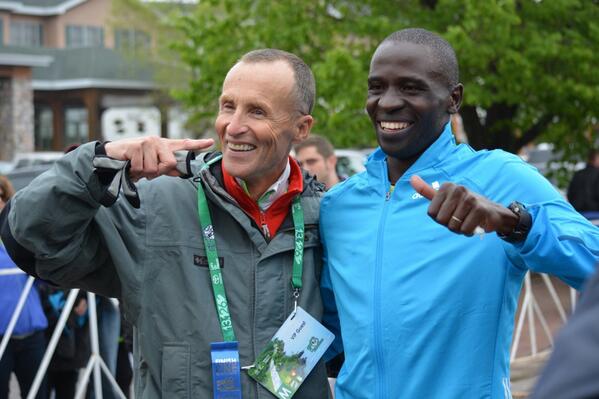 |
| The now past and present men's recordholders at Grandma's celebrate and pose for the cameras. |
Pasca Myers, a native of Kenya who is based in Iowa, won the women's race in 2:33:45. Myers had been fifth in last year's Grandma's, her marathon debut.
Another Kenyan, 32-year-old Julius Kosgei, won the Garry Bjorklund Half marathon in 1:03:36. Andrew Carlson ran 1:04:52 in eighth. Team USA Minnesota's Ben Sathre 13th in 1:06:16. Dan Greeno 15th in 1:06:20. Kevin Castille won the Masters in 1:05:36. Cynthia Limo of Kenya won the women's Half crown in 1:09:50 to finish a Kenyan sweep of the top places in the marathon and the Half. Six Minnesotans were in the top 25. Elizabeth Herndon was 15th in 1:16:17, Laura Paulsen 16th in 1:17:15, Elizabeth Turner 20th in 1:19:04, Heidi Peterson in 22nd in 1:19:08, Katie McGregor 23rd in 1:19:11, and UMD's Sam Rivard in 24th in 1:19:23.
Bjorklund Half Marathon results are HERE.
More updates and stories on Grandma's weekend from the Duluth News Tribune are HERE. More on Ondoro and the new record HERE. Strib Grandma's coverage is HERE and HERE.
Wednesday, June 04, 2014
News: Last Chance, Tollefson/Sifuentes, Sportsmanship, Beardsley, Reform, Thank You, Corportate Ethos, State Meet Results Link, Ryun, Hamstrings
Wayzata Last Chance Meet results are HERE.
Carrie Tollefson interviews Canadian Nicole Sifuentes, IAAF World Indoor medallist HERE.
University of Minnesota trio win Big Ten Sportsmanship awards HERE.
MinnPost story on Dick Beardsley is HERE.
With all of the talk about need for reform within USATF, an interesting article on how the International Cycling federation, UCI, is approaching reform in their sport HERE.
The value of a thank you HERE.
A not uncommon view of corporate ethos, cheating, absorbed into Corporate Challenge Road Races HERE.
Live results of MSHSL Track Championships will be HERE Friday and Saturday.
For the World, Roger Bannister's sub-four minute mile was earth shattering, but for many US distance runners a landmark moment came in 1965 when a high school senior, Jim Ryun, topped becoming the first US high school runner to break four minutes the year before by beating the reigning Olympic champion at both 800 and 1500 meters, Peter Snell, running the then US HS record of 3:55.3. Toni Reavis asks if this weekend's 50th Anniversary of Ryun's 3:59.0 mile in 1964 will attract a crowd to the track HERE.
Hamstring troubles? NYT article on an exercise that may help is HERE.
FloTrack workout Wednesday with Hassan Mead, Will Leer, and Ciaran O'Leonard is HERE.
Tuesday, November 05, 2013
Photo ID Bio: The Grey Ghost
When I moved to Minnesota in 1972 the thing that impressed me most about the area was the inclusivness of the Minnesota distance running community. There was an abundance of top level runners of high school, college, and post graduate ages, some of whom would become very influential people in the running world. The "glue" that held the Minnesota distance running community together, however, were the Masters. They were masters in every sense of the word. They dominated US Masters distance running and imparted their knowledge, enjoyment, and enthusiasm fro the sport to the younger runners.
One of the them was Dr. William Andberg, an Anoka veterinarian who had a multitude of nicknames. Bill, of course. Bullet Bill for his ability to sprint at the end of distance races, and the Flying Finn for his ethnic heritage and running ability that produced more than 30 US and World Masters records. But the nickname that stuck was that of the Grey(the UK spelling of gray, which is used inerchangably with grey in the US) Ghost. It was a particularly fitting moniker because it conveyed the wit and humor Andberg had in abundance.
He got the name because he had the habit of running through the cemetary in Anoka in an attempt to avoid attention and, punch line here for a vet, to get away from dogs. Some women saw this old guy in shorts and a T-shirt running past the headstones and called the police. "They thought I was an escapee from the state hospital,'' Andberg said. "I'm the Grey Ghost because I run in the cemetery to remind myself that I'm above the tombstones, not below.''
The other irony of his choice of running routes was that he had a joy for life that was infectious. He worked as a vet until he was 88. In addition to running he had a passion for other sports including pole valuting as a high schooler, snow shoeing, cross country skiing, golf, and bowling. And he was good at all of them. His skills were not limited to athletics as he also sang and played the violin. Even when he was standing still his mind was doing mental gymnastics inventing humorous takes on what had or was happening around him.
Though he ran 35 marathons it was not his favorite sporting activity, inviting one of his legendary quips: “Dick Beardsley says he can remember every mile. I can only remember when I started, when I finished and when I vomited.”
His athletic endeavors got him inducted into several Hall of Fames, but the lasting memory for many is what he gave back to one of the sports he enjoyed. He was the founder of the annual Gray Ghost Run in Anoka during Haloween week. Instead of buying trophies for the winners, he donated trophies he had won during his career, thus giving the winners not just another piece of wood and metal, but a link to the past.
Andberg died in 2007 at the age of 96 having led a full and, probably for him, too short life. He squeezed everything he could out of the time he had.
One of the them was Dr. William Andberg, an Anoka veterinarian who had a multitude of nicknames. Bill, of course. Bullet Bill for his ability to sprint at the end of distance races, and the Flying Finn for his ethnic heritage and running ability that produced more than 30 US and World Masters records. But the nickname that stuck was that of the Grey(the UK spelling of gray, which is used inerchangably with grey in the US) Ghost. It was a particularly fitting moniker because it conveyed the wit and humor Andberg had in abundance.
 |
| Andberg displaying his sense of humor with the lapel button that reads: I Did It in Goteborg. Photo by Jim Ferstle |
He got the name because he had the habit of running through the cemetary in Anoka in an attempt to avoid attention and, punch line here for a vet, to get away from dogs. Some women saw this old guy in shorts and a T-shirt running past the headstones and called the police. "They thought I was an escapee from the state hospital,'' Andberg said. "I'm the Grey Ghost because I run in the cemetery to remind myself that I'm above the tombstones, not below.''
The other irony of his choice of running routes was that he had a joy for life that was infectious. He worked as a vet until he was 88. In addition to running he had a passion for other sports including pole valuting as a high schooler, snow shoeing, cross country skiing, golf, and bowling. And he was good at all of them. His skills were not limited to athletics as he also sang and played the violin. Even when he was standing still his mind was doing mental gymnastics inventing humorous takes on what had or was happening around him.
Though he ran 35 marathons it was not his favorite sporting activity, inviting one of his legendary quips: “Dick Beardsley says he can remember every mile. I can only remember when I started, when I finished and when I vomited.”
His athletic endeavors got him inducted into several Hall of Fames, but the lasting memory for many is what he gave back to one of the sports he enjoyed. He was the founder of the annual Gray Ghost Run in Anoka during Haloween week. Instead of buying trophies for the winners, he donated trophies he had won during his career, thus giving the winners not just another piece of wood and metal, but a link to the past.
Andberg died in 2007 at the age of 96 having led a full and, probably for him, too short life. He squeezed everything he could out of the time he had.
 |
| Bill Andberg with Emily Lanin sharing memories. |
Thursday, September 05, 2013
Dick Beardsley returns to North Dakota
Subscribe to:
Posts (Atom)